Today's
EarthStation1.com 15% Off Commemorative Memorial Title: James
Joyce's Ulysses + Portrait Of The Artist DVD, MP4, USB Drive
Today, October 25, 2025
October 25: International Artist Day: --
Art as a creative human expression encapsulates myriad things. It
portrays the beauty of life or a bitter reality. It records
history, revolutions, rebellions, and sometimes is a means to
escape them. In short, there is no history or culture without art.
This day celebrates all forms of art - paintings, sculpture,
photography, architecture, literature, music, and more. Through
this celebration we show our respect for the passion and
creativity in all artists. In the summer of 1961 President Kennedy
made an effort to settle a salary dispute between the Metropolitan
Opera and the American Federation of Musicians. He succeeded.
Kennedy's actions signaled his passion for the arts. Congress, in
the mid 60s, designated the National Cultural Center, launched in
1958, as a "living memorial" to President Kennedy and
authorized 23M USD to begin construction. It's now simply known as
the Kennedy Center. The following year President Johnson signed
the National Foundation on the Arts & the Humanities Act,
which created the National Endowment for the Arts. By 1970 focus
on the arts increasingly spread to television and cinema. Mobil
Oil committed more than 1M USD to the Corporation for Public
Broadcasting for presentation of Masterpiece Theatre on PBS - and
for 5 million copies of new Sesame Street magazine to be given
free to preschool children in low-income neighborhoods. This was
the largest gift to CPB from the business community to date. A
decade later President Reagan, himself a former actor appointed a
Presidential Task Force on the Arts & Humanities to review the
purposes of the National Endowments; broaden private support;
engage more non-government professionals, private groups &
individuals; & recommend ways to strengthen the overall
structure of both agencies. Still another president would show his
support as well. Bill Clinton, in his 1997 State of the Union
Address, asked Congress to maintain support for the arts - and
urged citizens to make the year 2000 a national celebration "so
that we can remain the world's beacon not only of liberty but of
creativity, long after the fireworks have faded." Recently
the Museum of Modern Art in New York City reopened after a 400M
USD renovation - adding over 40,000 square feet for galleries
(including two at the street-level)- inside the new West 53rd St.
tower. They are free to the public. On Sale @ 15% Off Discount
Till Midnight PT!
https://store.earthstation1.com/james-joyce39s-ulysses-dvd-dramatic-documenta39.html
Today's
EarthStation1.com 15% Off Commemorative Memorial Title: The
Hermitage Museum World's Greatest Art Collections MP4 Download DVD
Today, October 25, 2025
October 25: National Fine Art Appreciation Day: -- A day for doing every conceivable thing that translates to appreciating all works of fine arts. These include things like just admiring, looking at and studying art, and buying it. Many people express their awe at particular works of art throughout the day, with some even going so far as to buy them from galleries. Did you know that the world's most valuable painting sold for over half a billion dollars at auction? Isn't that astounding? That's how much a lovely piece of art may be appreciated. Join us today in celebrating! RoGallery, a famous New York City-based art gallery, founded National Fine Art Appreciation Day in 2018. The date of October 25 was chosen to honor the gallery's love for Pablo Picasso, a well-known cubist artist. The gallery organized the day to allow visitors to appreciate artworks to demonstrate its dominance in the American art gallery sector for over 30 years. The day is also intended to motivate artists to create more intriguing, bold, and emotional pieces of art. To commemorate the occasion, the gallery offers free delivery on all purchases. Humans have been putting their life events and imaginations on concrete surfaces since the paleolithic era in Ancient Egypt. The artistic skill of the first men can be seen in cave engravings dating back over three thousand years. Fine arts evolved alongside man. Art styles such as mannerism, realism, cubism, and modern art are all results of diverse human historical timelines. Art forms emerge as a result of the purpose for which they were created. Romanticism, which ruled from the late 18th to the mid-19th centuries, encouraged painters to paint outside in the open. Around the year 1000 A.D., the early Christians employed artwork to communicate knowledge to the majority of Christians who were illiterate. The famous cubism art movement, in which Picasso reigns supreme, was a product of the early 20th century. This art form has survived many decades of continuous modifications and still competes with artworks of contemporary forms. RoGallery encourages museums, art galleries, or individuals to celebrate the day by posting about it on social media. On Sale @ 15% Off Discount Till Midnight PT! https://store.earthstation1.com/hemuwogrartc.html
Today's
EarthStation1.com 15% Off Commemorative Memorial Title: Antony and
Cleopatra (1991) DVD, MP4 Video Download, USB Flash Drive
Today, October 25, 2025
October 25: World Opera Day: -- A day to
enjoy the dramatic, high-note arias and grand stages of a classic
art form that's stood the test of time. Opera is a classical style
of musical performance that dates back more than 400 years.
Throughout its lifetime of many centuries, opera continues to
remain relevant in the modern era. As it offers an impact to the
arts programs in countries and cities all over the world, it
brings an artistic impact to individuals and families, both young
and old. In celebration of this musical art form, World Opera Day
acts as an international initiative to showcase the variety of
ways that opera companies and their artists work to enrich the
lives of individuals and communities. World Opera Day is a
collaboration between three different organizations, including
OPERA America, Opera Europe and Opera Latinoamerica. The day is
scheduled to be celebrated as a nod to the birthdays of two
powerhouse composers in the world of opera and operetta music:
Georges Bizet, who was born on October 25, 1838 and Johann Strauss
II, whose date of birth was October 25, 1825. This is a one-day
event that builds on the legacy of OPERA America's National Opera
Week, which is a 10-year program established by the National
Endowment of the Arts in celebration of the vibrancy of American
opera. World Opera Day takes place each year to provide an
opportunity for administrators, artists, trustees and audiences
from the opera industry to share their passion for opera to help
make the world a better place! This includes sharing about local
companies, offering insight into personal practices, and
encouraging others to experience the art form themselves. Each
year, World Opera Day takes on a unique theme that encourages
people to focus on a certain aspect of this art form. Previous
themes have included ideas like Unboxing Opera (2022) and Opera
Reboot (2021). On Sale @ 15% Off Discount Till Midnight PT!
https://store.earthstation1.com/antony-amp-cleopatra-samuel-barber39s-opera-shakespeare39s-words3939.html
Today's
EarthStation1.com 15% Off Commemorative Memorial Title: Rock &
Roll An Unruly History 10 Part TV Series MP4 Video Download DVD
Today, October 25, 2025
October 25: Punk For A Day Day: --
Today's all about celebrating the punk movement, as well as punk
music. This is because the movement is amongst the largest in the
world and has some distinguishing factors. For instance, punks
dress in a certain way and possess a non-conformist attitude. Due
to this, they are often stereotyped and treated as outsiders.
However, this does not change how great the movement is as people
continue to join it even today. Moreover, punk bands are heard
across the world and the form of music is created in different
languages. Here is more on the glorious history of the movement.
Punk For a Day Day celebrates the rich history of punk rock and
breaks stereotypes a few individuals have against the punk
movement. The initial movement started after the hippie movement
and had its distinctive style since it focused on rage-filled
cynicism. This is why punk music is aggressive and loud. Though
punk music emerged around the 1960s it gained popularity quickly
and various punk rock bands emerged across the world. The movement
received admiration since the ideology behind it was one of
rebellion. The term widely spread in Britain in the late '70s
after the emergence of the band Sex Pistols. They were dressed in
a particular way to promote the Malcolm McLaren London store. The
aesthetics of the clothes included rips, fractures, and tensions,
and also successfully captured the dark mood of punk music. After
this, fetishwear became extremely popular. During this time, punk
trickled over from music to art, writing, fashion, and
performance. By 1977, the Sex Pistols had several massive hits
such as 'God Save the Queen' and 'Pretty Vacant.' These songs put
Britain on the world map, and punk became an instant trend with
the youth. Similar movements during this period started to occur
in France, Australia, and the United States. Places like
Cleveland, Ohio, had bands like Pere Ubu that became highly
popular. Unfortunately, the punk movement took a backseat in the
U.S in the later 1970s and was taken over by disco. Punk came back
in fashion once again in 1991, after the success of the band
Nirvana. On Sale @ 15% Off Discount Till Midnight PT!
https://store.earthstation1.com/rock-amp-roll-an-unruly-history-10-part-tv-series-mp4-video-download-104.html
Today's
EarthStation1.com 15% Off Commemorative Memorial Title: Soldiers:
A History Of Men In Battle TV Series + Bonus Title DVD MP4
Today, October 25, 2025
October 25, 1415: The Crisis Of The Late
Middle Ages (c. 1315 - c. 1487): The Anglo-French Wars
(1109-1815): The Hundred Years' War (French: Guerre De Cent Ans
[1337-1453]): The Lancastrian War (1415-1453): The Battle Of
Agincourt: -- In one of the most significant and celebrated
battles in history, Henry V of England and his lightly armoured
infantry and archers defeat the heavily armoured French cavalry in
the Battle of Agincourt. This battle is notable for the use of the
English longbow in very large numbers, with the English and Welsh
archers forming up to 80 percent of Henry's army. It is recounted
in William Shakespeare's play "Henry V". The French
suffered between 7,000 and 10,000 dead, with an additional 1,500
noblemen taken prisoner and executed, while the English lost
around 600 dead. It took place on the feast day of Saints Crispin
and Crispinian, patron saints of cobblers, curriers, tanners, and
leather workers, who were beheaded during the reign of Diocletian
for being Christians; the date of their execution being given as
October 25th of 285 or 286. On Sale @ 15% Off Discount Till
Midnight PT!
https://store.earthstation1.com/soldiers-a-history-of-men-in-battle-4-dvds-all-13-sh413.html
Today's
EarthStation1.com 15% Off Commemorative Memorial Title:
Montparnasse Revisited: The Genius That Was Paris DVD, MP4, USB
Drive
Today, October 25, 2025
October 25, 1881: #BOTD: #HBD! Pablo
Picasso, Spanish painter, sculptor, printmaker, ceramicist, stage
designer, poet and playwright (d. April 8, 1973) is #born Pablo
Ruiz Picasso in the city of Malaga, Andalusia, in southern Spain.
He spent most of his adult life in France, mainly in the
Montparnasse and Montmartre sections of Paris. Regarded as one of
the most influential artists of the 20th century, he is known for
co-founding the Cubist movement, the invention of constructed
sculpture, the co-invention of collage, and for the wide variety
of styles that he helped develop and explore. Among his most
famous works are the proto-Cubist Les Demoiselles d'Avignon
(1907), and Guernica (1937), a dramatic portrayal of the bombing
of Guernica by the German and Italian airforces. Picasso achieved
universal renown and immense fortune for his revolutionary
artistic accomplishments, and became one of the best-known figures
in 20th-century art. Pablo Picasso died in Mougins, France, from
pulmonary edema and a heart attack, the morning after he and his
wife Jacqueline entertained friends for dinner, aged 91. He is
interred at the Chateau of Vauvenargues near Aix-en-Provence, a
property he had acquired in 1958 and occupied with Jacqueline
between 1959 and 1962. Jacqueline prevented his children Claude
and Paloma from attending the funeral. Devastated and lonely after
the death of Picasso, Jacqueline killed herself by gunshot in 1986
when she was 59 years old. On Sale @ 15% Off Discount Till
Midnight PT!
https://store.earthstation1.com/montparnasse-revisted-the-genius-that-was-paris-3-dvd3.html
Today's
EarthStation1.com 15% Off Commemorative Memorial Title: Victory At
Sea (1954) Rare WWII Movie DVD, MP4 Download, USB Stick
Today, October 25, 2025
October 25, 1944: World War II: The
Pacific War (The Asia-Pacific War, The Asiatic-Pacific Theater,
The Pacific Theater Of World War II): The Pacific Ocean Theater Of
World War II: The Southwest Pacific Theater Of World War II: The
Philippines Campaign (1944-1945) (Battle Of The Philippines,
Second Philippines Campaign, The Liberation Of The Philippines,
Operation Musketeer I, II, and III): The Battle Of Leyte Gulf: The
Battle Of Surigao Strait (October 25, 1944) -- One of the most
extraordinary naval engagment in United States naval history on a
number of accounts, as well as the last battleship-to-battleship
action in history, occurs when six of the American battleships the
Japanese sunk or damaged during the Attack On Pearl Harbor -- all
of which the Japanese did not know had been refloated and returned
to service until this battle -- the West Virginia, Maryland,
Mississippi, Tennessee, California, and Pennsylvania -- obtained
their revenge against the Japanese fleet for the attack when the
unsuspecting Japanese fleet sailed through the narrow Surigao
Strait, as the US Navy knew they would due to intercepted and
decoded Japanese naval communications, were savagely ambushed at
night at the moment when the Japanese ships "crossed the T"
(see below) using a new American secret weapon: the proximity
fuse, which did not require a direct hit on a target for the fired
shell to detonate on the target, all shot from (48) 14-inch (356
mm) guns and (16) 16-inch (406 mm) guns. The attack was so planned
that it was in effect more like a gangland hit squad execution
than a battle. The Battle Of Surigao Strait was one of only two
battleship-versus-battleship naval battles in the entire Pacific
campaign of World War II (the other being the naval battle during
the Guadalcanal Campaign, where the battleship USS Washington sank
the Japanese battleship Kirishima). It is also the most recent
battle in which one force (in this case, the U.S. Navy) was able
to "cross the T" ("capping the T" of its
opponent, a classic naval warfare tactic used from the late 19th
to the mid-20th centuries in which a line of warships crosses in
front of a line of enemy ships to allow the crossing line to bring
all their guns to bear while it receives fire from only the
forward guns of the enemy. On Sale @ 15% Off Discount Till
Midnight PT!
https://store.earthstation1.com/victory-at-sea-1954-dvd-the-movie-rare-wwii-1954.html
Today's
EarthStation1.com 15% Off Commemorative Memorial Title: Admiral
William Halsey Documentaries & Biographies DVD, Download, USB
Today, October 25, 2025
October 25, 1944: World War II: The
Pacific War (The Asia-Pacific War, The Asiatic-Pacific Theater,
The Pacific Theater Of World War II): The Pacific Ocean Theater Of
World War II: The Southwest Pacific Theater Of World War II: The
Philippines Campaign (1944-1945) (Battle Of The Philippines,
Second Philippines Campaign, The Liberation Of The Philippines,
Operation Musketeer I, II, and III): The Battle Of Leyte Gulf: The
Battle Off Samar (October 25, 1944) -- The centermost action of
The Battle Of Leyte Gulf takes place in the Philippine Sea off
Samar Island,in the Philippines. It was the only major action in
the larger battle in which the Americans were largely unprepared.
After the previous day's fighting, the Imperial Japanese Navy's
First Mobile Striking Force, under the command of Takeo Kurita,
had suffered significant damages and appeared to be retreating
westward. However, by the next morning, the Japanese force had
turned around and resumed its advance toward Leyte Gulf. With
Admiral William Halsey Jr. lured into taking his powerful Third
Fleet north after a decoy fleet and the Seventh Fleet engaged to
the south, the recently-landed 130,000 men of the Sixth Army were
left vulnerable to Japanese attack on Leyte. Kurita, aboard the
battleship Yamato, took his large force of battleships, cruisers
and destroyers from the San Bernardino Strait and headed south
toward Leyte, where they encountered Task Unit 77.4.3 ("Taffy
3"), the northernmost of the three escort carrier groups
under Rear Admiral Clifton Sprague that comprised the only
American forces remaining in the area. Composed of only six small
escort carriers, three destroyers, and four destroyer escorts,
Taffy 3 was intended to provide shore support and anti-submarine
patrols, and did not have guns capable of penetrating the Japanese
armor. The Japanese opened fire shortly after dawn, targeting
Taffy 3's escort carriers, which Kurita mistook for the main
carriers of the Third Fleet. The escort carriers fled for the
cover of rain squalls and launched their aircraft in defense,
while the three destroyers, led by USS Johnston, launched a
torpedo attack that sank one ship and sent the Japanese strike
force into disarray. Japanese aircraft from the base at Luzon
launched kamikaze attacks on the retreating American task force,
sinking one escort carrier and damaging three others. With Taffy
2's aircraft joining the battle, the increasing severity of the
air attack further convinced Kurita that he was engaging the Third
Fleet's surface carriers. Satisfied with sinking what he believed
were multiple carriers and worried the bulk of the Third Fleet was
approaching, Kurita withdrew his fleet north, having failed to
carry out his orders to attack the landing forces at Leyte Gulf.
Taffy 3 sustained heavy losses in the action, losing two escort
carriers, two destroyers, a destroyer escort and numerous
aircraft. Over 1,000 Americans died, comparable to the combined
losses of American men and ships at the Coral Sea and Midway.
Three Japanese cruisers were sunk by air attack, and three others
were damaged. The Japanese had over 2,700 casualties. Taffy 3 was
awarded the Presidential Unit Citation and Captain Ernest E. Evans
of the sunk Johnston was posthumously awarded the Medal of Honor.
Fleet Admiral Chester W. Nimitz wrote afterwards that the success
of Taffy 3 was "nothing short of special dispensation from
the Lord Almighty." The Battle off Samar has been cited by
historians as one of the greatest last stands in naval history. On
Sale @ 15% Off Discount Till Midnight PT!
https://store.earthstation1.com/admiral-william-halsey-documentaries-dvd-world-war-ii.html
Today's
EarthStation1.com 15% Off Commemorative Memorial Title: The
Emperor's Eye: Taiwan's National Palace Art Museum DVD, MP4, USB
Today, October 25, 2025
October 25: Retrocession Day (Taiwan): --
October 25, 1945: World War II: The Pacific War (The Asia-Pacific
War, The Asiatic-Pacific Theater, The Pacific Theater Of World War
II): The Pacific Ocean Theater Of World War II: China: The History
Of China: The Century Of Humiliation (The Hundred Years Of
National Humiliation) (1838-1945): Taiwan Under Japanese Rule:
Taiwan Under Republic Of China Rule: -- Fifty years of Japanese
administration of Taiwan formally ends when the Republic Of China
assumes control. Retrocession Day is the annual observance and
former public holiday in Taiwan commemorating the end of Japanese
rule of Taiwan and Penghu and the claimed retrocession ("return")
of Taiwan to the Republic Of China on October 25, 1945. However,
the idea of "Taiwan retrocession" remains in dispute.
Taiwan, then more commonly known to the Western world as
"Formosa", became a colony of the Empire of Japan after
the Qing dynasty lost the First Sino-Japanese War in 1894 and
ceded the island with the 1895 Treaty of Shimonoseki. Japanese
rule in Taiwan lasted until the end of World War II. In November
1943, Chiang Kai-shek took part in the Cairo Conference with
Franklin D. Roosevelt and Winston Churchill, who firmly advocated
that Japan be required to return all of the territory it had
annexed into its empire, including Taiwan and the Penghu
(Pescadores) Islands. Article 8 of the Potsdam Declaration,
drafted by the United States, United Kingdom, and China in July
1945, reiterated that the provisions of the Cairo Declaration be
thoroughly carried out, and the Japanese Instrument of Surrender
stated Japan's agreement to the terms of the Potsdam Proclamation.
Under the authorization of American General Douglas MacArthur's
General Order No. 1, Chen Yi (Chief Executive of Taiwan Province)
was escorted by George H. Kerr to Taiwan to accept the Japanese
government's surrender as the Chinese delegate. When the Japanese
surrendered at the end of World War II, General Rikichi Ando,
governor-general of Taiwan and commander-in-chief of all Japanese
forces on the island, signed a receipt of Order No. 1 and handed
it over to Governor-General of Taiwan Chen Yi, representing the
Republic Of China Armed Forces to complete the official turnover
in Taipei (known during occupation as Taihoku) on October 25,
1945, at Taipei City Public Auditorium (now Zhongshan Hall). Chen
Yi proclaimed that day to be "Retrocession Day" and
organized the island into the Taiwan Province of the Republic Of
China. Chen Yi's unilateral act, however, did not gain agreement
from the US and the UK as both considered Taiwan still under
military occupation pending a peace treaty, though the US accepted
Chinese authority over Taiwan at the time and viewed the Republic
Of China as the legal government of China. Taiwan has since been
governed by The Government Of The Republic Of China. On Sale @ 15%
Off Discount Till Midnight PT!
https://store.earthstation1.com/the-emperors-eye-dvd-world39s-greatest-chinese-art-collecti39.html
Today's
EarthStation1.com 15% Off Commemorative Memorial Title: Great Wall
Of Iron Chinese People's Army TV Series + Bonus DVD MP4 USB
Today, October 25, 2025
October 25, 1949: China: The History Of
China: China: The History Of China: The Aftermath Of World War II:
The Cold War: The Cold War (1947-1953): The Cold War In Asia: The
Chinese Civil War: The Chinese Civil War Second Phase (August 10,
1945 - December 7, 1949): The Cross-Strait Relations
(Mainland-Taiwan Relations, China-Taiwan Relations, Taiwan-China
Relations, Taiwan-China Relations): The Battle Of Guningtou (The
Battle Of Kuningtou, The Battle Of Guningtou, The Battle Of
Quemoy, The Battle Of Kinmen): -- The Chinese Communist Party's
People's Liberation Army (PLA) forces provoke a fight with the
Republic Of China (ROC) garrisons on the island of Quemoy (Kinmen)
in the Taiwan Strait, beginning a battle fought over control of
Kinmen. As the PLA executed a quiet approach to Kinmen, a
Nationalist patrol accidentally set off one of the island's land
mines at around 01:30, and the invasion was compromised. The blast
alerted other units all along the northern shore and .
Immediately, flares were fired into the air by ROC troops and
searchlights swept the area, which brightly illuminated the PLA's
fleet and led to their discovery by the Nationalists. At the time
of the discovery, a tank squadron consisting of Tanks 64 and 65,
were guarding a tank receiving maintenance (having been stuck in
sand the evening prior). Upon seeing the illuminated PLA attack
force, the soldiers began returning fire with the tanks. According
to reported accounts, an ammunition ship was one of the first hit
by ROC tank fire, resulting in a fire that burned neighboring
landing craft. At about 02:00 when the tide had begun to recede,
PLA troops from regiments 244, 251, and 253 landed on the north
side of Greater Kinmen Island at Guningtou (Ku-ning-t'ou), Huwei
and Longkou. Regiment 244 was the first ashore landing near
Lungkou where Nationalist defenders raked them with machine-gun
fire, artillery, and mortars. They suffered heavy casualties.
Regiments 251 and 253 fared better, landing near Guningtou and
Huwei respectively where they broke through ROC defenses and
continued to head inland. Arriving at high tide, many of the PLA
landing vessels became caught on submerged anti-amphibious landing
beach obstacles and immobilized. When the tide went out, the PLA
landing vessels became beached and were unable to return to the
mainland to transport the second wave of reinforcements. Although
these Communists were initially supported by artillery fire from
the mainland, it had to cease firing once the infantry
disembarked. Some of the troops, stranded in their vulnerable
landing craft still far from shore, had to swim or wade some 650
yards (600 meters) in order to reach the shore, also rendering
them without cover and extremely vulnerable to the defenders'
fire. The beached PLA vessels were destroyed shortly afterwards by
gunfire from two ROC Navy vessels patrolling off the northwest
coast of Guningtou, strafing runs by ROCAF P-51s, as well as by
ROC troops who burned the mostly wooden boats using flamethrowers,
grenades, gasoline, and oil. The advancing PLA forces were met by
the ROC 18th Army and US-made M5A1 tanks of ROC 1st Bn, 3rd Tank
Regiment. PLA Regiment 244 held high ground at Shuangru Hill, but
were beaten back by ROC armor by early morning. PLA Regiment 253
holding Guanyin Hill and the Huwei Highlands were also forced to
fall back by 12:00 after an overwhelming ROC counterattack of
infantry, tanks, and soldiers with flamethrowers, and supported by
mortars and artillery. The PLA troops were attacked from three
sides. PLA Regiment 251 managed to break out of an ROC
encirclement and entered the village of Guningtou, and dug in at
Lincuo. Shortly afterwards, Regiment 251 was attacked by the ROC
14th and 118th divisions, with the ROC 118th division suffering
heavy casualties. By the end of the day, the PLA had lost its
beachheads at Huwei and Lungkou. At 03:00 on October 26, around
1,000 troops in 4 companies from PLA Regiment 246 and the 85th
division landed on Kinmen to reinforce PLA forces already on the
island landing again at Huwei and Guningtou. At dawn, Regiment 246
managed to break through ROC forces surrounding the village of
Guningtou, making a rendezvous with the surviving PLA troops
taking cover in the town. At 06:30, the ROC 118th division
launched a counterattack along the northern coast on PLA forces in
Guningtou at Lincuo. The resulting battle was extremely bloody and
soon turned into urban warfare in the streets and alleyways of
Guningtou. With air support from P-47s and B-24s of the ROC Air
Force, ROC forces eventually prevailed, taking Lincuo by noon and
Nanshan at 3PM. Surviving PLA forces began falling back to the
coast. By the early morning of October 27, the surviving People's
Liberation Army forces had exhausted both their food and
ammunition supplies. 1,300 PLA troops retreated to the beaches
north of Guningtou. After a final ROC assault, the remaining PLA
troops surrendered to ROC forces at 10:00 on that day. All of the
PLA troops who had landed on Kinmen were either killed or
captured. Following the failure at Guningtou, PLA General Ye Fei
submitted an official apology to Mao Zedong asking to be punished
for his failure. General Ye attributed the failure of the
operation to three factors: an insufficient number of landing
vessels, failure to properly secure the beachheads, and the lack
of an overall commanding officer to oversee the three regiments
involved in the first wave. As Ye was one of Mao's favorite
generals, Mao never took any action against him. For ROC forces
accustomed to continuous defeats against the PLA on the mainland,
the victory at Guningtou provided a much-needed morale boost. The
failure of the PRC to take Kinmen effectively halted its advance
towards Taiwan. With the outbreak of the Korean War in 1950 and
the signing of the Sino-American Mutual Defense Treaty in 1954,
the Communist plans to invade Taiwan were put on hold. Due to the
PLA's defeat, the Battle of Guningtou was not widely publicized in
the PRC until early in the 21st century when the publication of
articles within the mainland examining reasons for its failure was
widely distributed. The army generally concluded that its lack of
amphibious landing experience, lack of sophisticated landing
craft, lack of armor, low attack-repelling ability, lack of
international recognition, and lack of intelligence services
contributed to their defeat. As they had expected to win the
battle after one day of fighting, they therefore did not bring
enough ammunition, supplies, food, and water, on the first wave
and also to a lesser degree during the second day's invasion. The
battle is seen as being highly significant in Taiwan, as it laid
the foundation for the current status quo relationship between
Taiwan and mainland China. The failure of the Communists to take
the island left it in the hands of the Kuomintang (Nationalists)
and crushed their chances of taking Taiwan to destroy the
Nationalists completely in the war. On Sale @ 15% Off Discount
Till Midnight PT!
https://store.earthstation1.com/the-great-wall-of-iron-chinese-people39s-army-history-tv-series-dvd-394.html
Today's
EarthStation1.com 15% Off Commemorative Memorial Title: Korea: The
Unknown War TV Korean War Series DVD, Download, USB Drive
Today, October 25, 2025
October 25, 1950: Korea: The History Of
Korea: The Aftermath Of World War II: The Cold War: The Cold War
In Asia: The Korean Conflict: The Cold War (1947-1953): The Cold
War In Asia: The Korean War: The Chinese First Phase Campaign (The
Chinese First Phase Offensive): -- The first military engagement
by the Chinese in the Korean War begins with an initial assault by
the Chinese People's Volunteer Army (PVA) under the command of
Peng Dehuai with 270,000 PVA troops (it was assumed at the time
that Lin Biao was in charge, but this notion had been disproved).
The PVA assault caught the UN troops by surprise, and employing
great skill and remarkable camouflage ability, concealed their
numerical and divisional strength after the first engagement with
the UN. After these initial engagements, lasting from October 25
to November 5, 1950, the Chinese withdrew into the mountains. UN
forces interpreted this withdrawal as a show of weakness; they
thought that this initial attack was all that the Chinese forces
were capable of undertaking. On Sale @ 15% Off Discount Till
Midnight PT!
https://store.earthstation1.com/korea-the-unknown-war-dvd-complete-6-part-tv-series-3-dis63.html
Today's
EarthStation1.com 15% Off Commemorative Memorial Title: Korea: The
Forgotten War Hosted By Robert Stack DVD, Download, USB
Today, October 25, 2025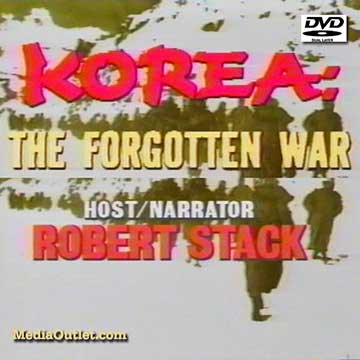
October 25, 1950: Korea: The History Of
Korea: The Aftermath Of World War II: The Cold War: The Cold War
In Asia: The Korean Conflict: The Cold War (1947-1953): The Cold
War In Asia: The Korean War: The Chinese First Phase Campaign (The
Chinese First Phase Offensive): The Battle Of Unsan (The Battle Of
Yunshan): -- The Chinese People's Volunteer Army (PVA) begin a
series of repeated attacks against the Republic Of Korea Army
(ROK) 1st Infantry Division in an attempt to take advancing United
Nations Command (UNC) forces by surprise near Unsan, North Pyongan
province in present-day North Korea, attacks which last until
November 4. In an encounter with the United States military on
November 1, the PVA 39th Corps attacked the unprepared U.S. 8th
Cavalry Regiment in Unsan, resulting in one of the most
devastating U.S. losses of the war. On Sale @ 15% Off Discount
Till Midnight PT!
https://store.earthstation1.com/korea-the-forgotten-war-with-robert-stack-dvd.html
Today's
EarthStation1.com 15% Off Commemorative Memorial Title: Adlai
Stevenson: The Man From Libertyville DVD, Download, USB Drive
Today, October 25, 2025
October 25, 1962: Cuba: The History Of
Cuba: The Aftermath Of World War II: The Cold War: The Cold War
(1962-1979): The Cuban Cold War: The Cuban Missile Crisis: The
Cuban Missile Crisis Confrontation At The United Nations: -- Adlai
Stevenson shows photos at a meeting of the United Nations Security
Council proving that Soviet missiles are installed in Cuba. His
remarks from that meeting to the Soviet Ambassador to the UN have
become emblematic of The Aftermath Of World War II: The Cold War:
"Do you, Ambassador Zorin, deny that the U.S.S.R. has placed
and is placing medium- and intermediate-range missiles and sites
in Cuba? Yes or no - dont wait for the translation - yes or no";
when Zorin replied that Stevenson would get his answer "in
due course", Steven riposted "I am prepared to wait for
my answer until hell freezes over, if thats your decision."
On Sale @ 15% Off Discount Till Midnight PT!
https://store.earthstation1.com/adlai-stevenson-the-man-from-libertyville-dvd.html
Today's
EarthStation1.com 15% Off Commemorative Memorial Title: The Yom
Kippur War: The 1973 Arab-Israeli War MP4 Download DVD Set
Today, October 25, 2025
October 25, 1973: The Cold War: The Cold War (1962-1979): The Cold War Era Of Stagnation (1964-1982): The Arab Cold War (July 23, 1952 - February 11, 1979): The Arab-Israeli Conflict: The Israeli-Palestinian Conflict: The Yom Kippur War (The Ramadan War, The October War, The 1973 Arab-Israeli War, The Fourth Arab-Israeli War): United Nations Security Council Resolution 339 (UNSCR 339): -- The Yom Kippur War ends as Egypt and Israel accept the October 22 United Nations Security Council Resolution order to bring a ceasefire in the Yom Kippur War. The resolution called for the return of the combatant forces of both sides to the position they held on October 22, when the first of two cease fires came into effect, and a further contained a request from the United Nations Secretary-General to undertake measures toward the placement of observers to supervise the cease fire. The resolution was adopted with 14 votes to none; the People's Republic Of China did not participate in the voting. By October 24, the Israelis, who had improved their positions considerably and completed their encirclement of the Egyptian Third Army and Suez City, came within 100 kilometres (62 mi) of the Egyptian capital of Cairo. This development led to dangerously heightened tensions between the United States and the Soviet Union, and a second ceasefire was imposed cooperatively on that date, a ceasefire that became official on October 25, 1973, officially ending the war. The Yom Kippur War started on October 6, 1973 as Egypt and Syria launched attacks on Israeli positions on the East Bank of the Suez and the Golan Heights. The Yom Kippur War, Ramadan War, or October War, also known as the 1973 Arab-Israeli War, was a war fought by a coalition of Arab states led by Egypt and Syria against Israel from October 6 to 25, 1973. The fighting mostly took place in the Sinai and the Golan Heights, territories that had been occupied by Israel since the Six-Day War of 1967. Egyptian President Anwar Sadat wanted also to reopen the Suez Canal. Neither specifically planned to destroy Israel, although the Israeli leaders could not be sure of that. On Sale @ 15% Off Discount Till Midnight PT! https://store.earthstation1.com/yomkiwa19arw.html
Today's
EarthStation1.com 15% Off Commemorative Memorial Title: Heart Of
The Dragon TV Series DVD, Video Download, USB Flash Drive
Today, October 25, 2025
October 25, 1971: China: The History Of
China: China And The United Nations: The People's Republic Of
China's Replacement Of The Republic Of China At The United
Nations: The United Nations General Assembly Resolution 2758 (The
Resolution On Admitting Peking): -- A motion to recognize the
People's Republic Of China as the sole legal China, initiated by
17 UN members led by Albania, is passed as General Assembly
Resolution 2758. One of the victorious Allies of World War II (the
Chinese theatre of which was the Second Sino-Japanese War), the
Republic Of China (ROC) joined the UN as one of its founding
member countries in 1945. The subsequent resumption of the Chinese
Civil War between the government of Republic Of China and the
rebel forces of the Chinese Communist Party, led to the latter's
victory on the mainland and the establishment of the People's
Republic Of China (PRC) in 1949. Nearly all of Mainland China was
soon under its control and the ROC government (then referred to in
the West as "Nationalist China") retreated to the island
of Taiwan. The One-China policy advocated by both governments
dismantled the solution of dual representation but, amid the Cold
War and Korean War, the United States and its allies opposed the
replacement of the ROC at the United Nations until 1971, although
they were persuaded to pressure the government of the ROC to
accept international recognition of Mongolia's independence in
1961. The PRC sought to be recognized by the United Nations from
the 1950s, but at least until 1961, the United States managed to
keep the PRC out of the UN. The General Assembly Resolution 1668
which demanded a majority of two thirds for the recognition of new
members was adopted in 1961. Canada and other allies of the United
States individually shifted their recognitions of China to the
PRC, which the US opposed. Some attempted to recognize both Chinas
separately which both Chinas opposed declaring each one was the
only legitimate representative of China. Annual motions to replace
the ROC with the PRC were introduced first by the Soviet Union,
then India and also Albania, but these were defeated. Amid the
Sino-Soviet split and Vietnam War, United States President Richard
Nixon entered into negotiations with Chinese Communist Party
Chairman Mao Zedong, initially through a secret 1971 trip
undertaken by Henry Kissinger to visit Zhou Enlai. On October 25,
1971, a motion to recognize the People's Republic Of China as the
sole legal China, initiated by 17 UN members led by Albania, was
passed as General Assembly Resolution 2758. It was supported by
most of the communist states (including the Soviet Union) and
non-aligned countries (such as India), but also by some NATO
countries, such as the United Kingdom and France. After the PRC
was seated on 15 November 1971, Nixon then personally visited
mainland China the next year, beginning the normalization of
PRC-USA relations. The Republic Of China maintained the view it
was the sole legitimate representative of China until 1988, but
eventually turned to a foreign policy which sought international
recognition through a so-called checkbook diplomacy. These moves
have been opposed and mostly blocked by the People's Republic Of
China, forcing the Republic Of China to join international
organizations under other names, including "Chinese Taipei"
at the International Olympic Committee. The Republic Of China's
most recent request for admission was turned down in 2007, but a
number of European governments-led by the United States-protested
to the UN's Office of Legal Affairs to force the global body and
its secretary-general to stop using the reference "Taiwan is
a part of China". On Sale @ 15% Off Discount Till Midnight
PT!
https://store.earthstation1.com/heart-of-the-dragon-dvds-post-mao-china-all-12-tv-shows-3-di123.html
Today's
EarthStation1.com #OnThisDay Commemorative Memorial Title: Classic
Movie Trailers & Drive-In Movie Ads DVD, Download, USB Drive
Today, October 25, 2025 October 25: National Greasy Food Day: --
Those watching the scale beware! Augment the diet for National
Greasy Foods Day on October 25th. Although not the healthiest of
choices, every once in a while, it is okay to enjoy some greasy
food. From fried chicken, pizza, nachos, and french fries to bacon
and hash brown potatoes, we all like a treat in our regular diet.
Cooking oil types include: Olive oil - Palm oil - Soybean oil -
Canola oil - Pumpkin oil - Corn oil - Sunflower oil - Safflower
oil - Peanut oil - Grapeseed oil - Sesame oil - Agran oil - Rice
bran oil - Other vegetable oils - Butter and lard. Oil may be
flavored with aromatic flavorings such as herbs, chilies, or
garlic. Greasy foods can be prepared with healthier oils and with
much less than average amounts of oil used when cooking, making
them much healthier choices. For the educators and homeschoolers,
National Day Calendar tested an assignment in our own classroom
and made the material ready for you to use. To observe National
Greasy Foods Day: There are so many greasy foods to try! Which
will you try first? French fries come to mind. So do onion rings.
However, mozzarella sticks sound good, too. Don't forget the
dipping sauces! Indulge yourself with some greasy foods and use
#GreasyFoodsDay to post on social media.
https://store.earthstation1.com/classic-movie-trailers-and-drivein-movie-ads-dvds-2-disc-se2.html
October 25: National Greasy Food Day: --
Those watching the scale beware! Augment the diet for National
Greasy Foods Day on October 25th. Although not the healthiest of
choices, every once in a while, it is okay to enjoy some greasy
food. From fried chicken, pizza, nachos, and french fries to bacon
and hash brown potatoes, we all like a treat in our regular diet.
Cooking oil types include: Olive oil - Palm oil - Soybean oil -
Canola oil - Pumpkin oil - Corn oil - Sunflower oil - Safflower
oil - Peanut oil - Grapeseed oil - Sesame oil - Agran oil - Rice
bran oil - Other vegetable oils - Butter and lard. Oil may be
flavored with aromatic flavorings such as herbs, chilies, or
garlic. Greasy foods can be prepared with healthier oils and with
much less than average amounts of oil used when cooking, making
them much healthier choices. For the educators and homeschoolers,
National Day Calendar tested an assignment in our own classroom
and made the material ready for you to use. To observe National
Greasy Foods Day: There are so many greasy foods to try! Which
will you try first? French fries come to mind. So do onion rings.
However, mozzarella sticks sound good, too. Don't forget the
dipping sauces! Indulge yourself with some greasy foods and use
#GreasyFoodsDay to post on social media.
https://store.earthstation1.com/classic-movie-trailers-and-drivein-movie-ads-dvds-2-disc-se2.html
Today's
EarthStation1.com #OnThisDay Commemorative Memorial Title: TV
Commercials: The Cable Age Classics III DVD, Download, USB Drive
Today, October 25, 2025October 25: World Pasta Day: -- Carb
lovers of the world, lo and behold! People have been eating pasta
since at least 5,000 B.C. However, this delightful holiday was
only established in 1995, when 40 pasta producers from around the
world gathered to hold the globe's first World Pasta Congress.
Since then, the world has joined forces each October to pay
tribute to one of the most delicious and versatile foods known to
man. Whether you prefer rigatoni, angel hair, or pappardelle,
you'll love this holiday! The world has enjoyed this dish since
the first century AD. While legend has it that Marco Polo imported
pasta from China in the 1200s, British food writer Jane Grigson
believes a Canadian spaghetti company may have started that tale
in the 1920s. We do know that dried pasta surged in popularity
during the 14th and 15th centuries - mainly for its easy storage.
This allowed people to bring pasta along on ships when exploring
the New World. Hungary boasted a pasta factory in 1859, while
central Italy's Buitoni Company began churning out pasta a mere
eight years later. The trend moved into the present-day Czech
Republic by 1884. During a stay in Paris, President Jefferson ate
what he called "macaroni," but it might have been any
type of pasta. He eventually returned to America with two cases.
Pasta's popularity further blossomed in the U.S. during the late
19th century, when a large group of Italian immigrants (mostly
from Naples), moved to America. The World Pasta Day holiday itself
only recently began in 1995 when 40 pasta producers from around
the world gathered to hold the first World Pasta Congress. Since
then, diners around the world have joined forces each October to
pay tribute to one of the most delicious and versatile foods ever.
https://store.earthstation1.com/tv-commercials-the-cable-age-classics-iii-dvd.html
Today's
EarthStation1.com #OnThisDay Commemorative Memorial Title: TV
Commercials: The Classics Vol. 2 DVD, Video Download, USB Drive
Today, October 25, 2025October 25: Crisp Sandwich Day: --
Feeling snacky? Consider layering your favorite potato chips
between two slices of bread - a delicious way to satisfy your
cravings! When two pieces of bread contain just meat or cheese,
it's really just basic. But when those bread slices include
delicious potato crisps (or potato chips as they're called in the
US), then there's a whole new reason to celebrate! Now, Crisp
Sandwich Day is here to show appreciation for everything related
to this fun and simple little treat. While it may be unclear
exactly who invented the crisp sandwich, they seem to have cropped
up in a few different places. In Ireland, the crisp sandwich is
also called the Tayto sandwich, named after the popular Irish
brand of potato crisps. In other places they are called chippy
sandwiches, chip sandwiches, or even chipwiches! Some evidence
shows that potato chip sandwiches have been around in the United
States since the 1950s. Whether eaten alone (just crisps and
mayonnaise, please), or crispy snacks are piled on with ham &
cheese, bologna, or peanut butter, a crisp sandwich is a tasty
treat that is fun to enjoy. In 2015, two different people went so
far as to open establishments strictly dedicated to serving crisp
sandwiches, located in Belfast, Northern Ireland and West
Yorkshire, England. Both of these shops claim to have been the
first crisp sandwich shop in the world. Then, in 2021, Subway
sandwich shops in the UK started offering Walkers crisps as a
topping for their sandwiches. Though National Sandwich Day is
certainly a time that is worth celebrating, an even more niche and
interesting day to celebrate is Crisp Sandwich Day. Crisp Sandwich
Day offers a throwback to the good old days of magical simplicity!
https://store.earthstation1.com/tv-commercials-the-classics-vol-2-dv2.html
Today's
EarthStation1.com #OnThisDay Commemorative Memorial Title: Old
Time Kids Films Youth Social Guidance Films Set DVD, MP4, USB
Today, October 25, 2025October 25: Sourest Day: -- It's time for
a sensation overload that will make your mouth explode! We're not
just talking sucking on a lemon or boatloads of over-sugared
gummies. Today is a day for all things sour - from candy to
kimchi, sour foods can be an everyday part of our lives! Grab some
citrus and some yogurt, we're about to get puckerin'! Sour
candies, sour fruits, sour vegetables, sauerkraut. Sour foods have
been a staple in human diets around the world for centuries. And
while the term 'sour' typically brings to mind a puckering candy
or a rather irate person, it really encompasses so much more. Sour
foods have been on Earth much longer than humans. In fact, the
first crop of lemon trees has been traced to over eight million
years ago. Since then, dozens of cultures have experimented with
their own take on sour foods, most of which, as it turns out, are
good for your gut due to their similar fermentation processes. In
the 1st century B.C., Koreans had all but perfected the
fermentation of cabbage and other vegetables in a dish we now know
as kimchi, while 16th century Germans experimented with fermenting
cabbage mixed with salt, creating the classic sauerkraut dish we
know and love today. Of course, sour isn't just for vegetables.
The Parisians 'invented' lemonade as we know it today in the 1640s
by mixing lemon juice with water and honey, which quickly became a
summer staple across Europe, eventually leading to the classic
American lemonade stand that debuted in New York City over 130
years ago. And it wouldn't be until the 1970s that sour candies
took off, cementing sour's legendary association with pucker
mouths. While there are tons of rich food history and culture to
celebrate on Sourest Day, it's worth noting that the holiday was
never invented for sour foods: a fellow in Ann Arbor, Michigan,
launched Sourest Day in 1977 as a way to celebrate his good friend
whose last name was, you guessed it: Sauer.
https://store.earthstation1.com/old-time-kids-films-youth-social-guidance-films-dual-layer-dvd.html
Today's
EarthStation1.com #OnThisDay Commemorative Memorial Title: Curse
Of The Doll People aka Devil Doll Men 1961 DVD, MP4, USB Drive
Today, October 25, 2025October 25: National Chucky The Notorious
Killer Doll Day: -- This annual "celebration" of the
iconic character from the "Child's Play" franchise is
for all fans of slasher and horror films, and especially for the
fans of Chucky and all of the movies he has appeared in. "Child's
Play" is a movie franchise that is commonly known as "Chucky"
because of how iconic the character has become. The franchise has
about eight feature films with more in the pipeline and several
associated media featuring Chucky. The films and the character
have developed cult followings, leading to a day being set aside
to celebrate this important part of horror media. The franchise
began with the titular film "Child's Play," a
supernatural film with elements of both slasher and psychological,
pure horror in it. The film was the first in the series and the
first to feature Chucky. The film later came to be known as
"Chucky" because of how popular this main character was.
Chucky is a doll possessed by the soul of a serial killer called
Charles Lee Ray, nicknamed Chucky. As a human, Chucky is shot, and
when he realizes that he's bleeding out, he transfers his soul
into a doll. Throughout the various movies in the franchise,
Chucky is always trying to possess a human body again to continue
his murderous spree. The first film was a box office success and
established a cult following, which led to the creation of the
"Child's Play" media franchise that included several
feature films, shorts, and T.V. shows. Chucky is one of the most
recognizable horror movie icons today. Chucky fits in the killer
toys subgenre of horror films, and while the first film was pure
horror, the sequels have evolved and changed. The franchise would
now be described as slasher films as much as horror films.
Additionally, a lot of the pure horror elements of the first movie
have given way to a more self-aware look at the cult following of
the movies thus incorporating dark humor, satire, and camp
elements.
https://store.earthstation1.com/curse-of-the-doll-people-aka-devil-doll-men-dvd.html
Today's
EarthStation1.com #OnThisDay Commemorative Memorial Title: Classic
Family Values Films 1934-1957 DVD, Video Download, USB Drive
Today, October 25, 2025October 25: National I Care About You
Day: -- A day to plan something special for your friends and
family! This is the day where we honor everyone in our life for no
other reason but to tell them we are grateful. Although this
holiday was most recently launched in 2016, this day is highly
popularized through social media tags and post shares. Scroll down
to learn more inventive ways on how to celebrate those who make
life more beautiful. Let's be honest: We could easily make a case
that National I Care About You Day should sit atop a list of the
most important days of the year. Why? Though it was only started
in 2016, what other holiday more perfectly speaks to the human
condition? Money's nice to have. Vacations are fun. And driving
around in a new car makes us feel good - temporarily. None of it
matters at the end though. Without love (both romantic and
platonic), friendships, and/or family - we're doomed. Humans are
wired for relationships. We thrive when we're connected and feel
lonely (or worse) when we're disconnected. No amount of money can
make your emotional pain heal. But friends can. Or at least they
can help. So many of us crave "novelty," but by its very
definition, it can only last for a limited time. Suddenly you
don't even realize you're driving that (once) new car. And ancient
ruins begin to look the same starting around day 5 of your trip to
Greece. Material things can't possibly do what other people can
do. The health experts at Northwestern University have pinpointed
some of the positive effects of healthy relationships. For
instance, being in a committed relationship is linked to less
production of cortisol, a stress hormone. Good relationships can
promote better healing, as research suggests married people who
have undergone heart surgery are three times more likely to
survive the first three months after surgery than single patients.
Healthy relationships set the perfect tone for an overall healthy
lifestyle. They give us a greater sense of purpose. It's natural
for humans to want to feel needed, and like they're part of
something bigger. And it can even extend our lives! Research
indicates that having healthy social relationships makes a bigger
impact on avoiding an early demise than taking blood pressure
medication or being exposed to air pollution. One study even
suggests that a lack of social relationships has the same effect
on health as smoking 15 cigarettes a day. Ugh. So reach out on
October 25th. It will make your life better and may make someone
else's better too.
https://store.earthstation1.com/classic-family-values-films-193419341957.html
Today's
EarthStation1.com #OnThisDay Commemorative Memorial Title: Attack
In The Pacific (1945) + Eric Sevareid Bonus MP4 Download DVD
Today, October 25, 2025October 25, 1942: World War II: The
Pacific War (The Asia-Pacific War, The Asiatic-Pacific Theater,
The Pacific Theater Of World War II): The Pacific Ocean Theater Of
World War II: The South West Pacific Area (SWPA): Operation
Cartwheel: The Solomon Islands Campaign: The Battle Of Guadalcanal
(The Guadalcanal Campaign, Operation Watchtower): The Battle Of
The Santa Cruz Islands (The Battle Of Santa Cruz, The Third Battle
Of The Solomon Sea, (The Battle Of The South Pacific): -- The
Battle Of The Santa Cruz Islands (October 25-27, 1942), the fourth
carrier battle of the Pacific campaign of World War II and the
fourth major naval engagement fought between the United States
Navy and the Imperial Japanese Navy during the lengthy and
strategically important Guadalcanal campaign, begins as two
American task groups, one led by the carrier USS Hornet and the
other by carrier USS Enterprise, both under the overall command of
Rear Admiral Thomas Kinkaid, sweep around to the north of the
Santa Cruz Islands, searching for the Japanese naval forces. The
U.S. warships were deployed as two separate carrier groups,
separated from each other by about 10 nmi (19 km; 12 mi). A U.S.
PBY Catalina reconnaissance seaplane based in the Santa Cruz
Islands located the Japanese Main Body carriers at 11:03. However,
the Japanese carriers were about 355 nmi (657 km; 409 mi) from the
U.S. force, just beyond carrier aircraft range. Kinkaid, hoping to
close the range to be able to execute an attack that day, steamed
towards the Japanese carriers at top speed and, at 14:25, launched
a strike force of 23 aircraft. But the Japanese, knowing that they
had been spotted by U.S. aircraft and not knowing where the U.S.
carriers were, turned to the north to stay out of range of the
U.S. carriers' aircraft. Thus, the U.S. strike force returned to
its carriers without finding or attacking the Japanese warships.
The following day, October 26, 1942, the USS Hornet would be sunk
and the USS Enterprise heavily damaged, while two Japanese
carriers and one cruiser would be heavily damaged. As in the
battles of Coral Sea, Midway, and the Eastern Solomons, the ships
of the two adversaries were rarely in direct visual range of each
other. Instead, almost all attacks by both sides were mounted by
carrier or land-based aircraft. In an attempt to drive Allied
forces from Guadalcanal and nearby islands and end the stalemate
that had existed since September 1942, the Imperial Japanese Army
planned a major ground offensive on Guadalcanal for 20-25 October
1942. In support of this offensive, and with the hope of engaging
Allied naval forces, Japanese carriers and other large warships
moved into a position near the southern Solomon Islands. From this
location, the Japanese naval forces hoped to engage and decisively
defeat any Allied (primarily U.S.) naval forces, especially
carrier forces, that responded to the ground offensive. Allied
naval forces also hoped to meet the Japanese naval forces in
battle, with the same objectives of breaking the stalemate and
decisively defeating their adversary. The Japanese ground
offensive on Guadalcanal was under way in the Battle For Henderson
Field while the naval warships and aircraft from the two
adversaries confronted each other on the morning of 26 October
1942, just north of the Santa Cruz Islands. After an exchange of
carrier air attacks, Allied surface ships were forced to retreat
from the battle area with one carrier sunk and another heavily
damaged. The participating Japanese carrier forces also retired
because of high aircraft and aircrew losses plus significant
damage to two carriers. Although a tactical victory for the
Japanese in terms of ships sunk and damaged, the loss of many
irreplaceable, veteran aircrews would prove to be a long term
strategic advantage for the Allies, whose aircrew losses in the
battle were relatively low and could be quickly replaced. The
Guadalcanal Campaign, also known as the Battle Of Guadalcanal and
codenamed Operation Watchtower was a military campaign fought
between 7 August 1942 and 9 February 1943 on and around the island
of Guadalcanal in the Pacific theater of World War II. It was the
first major offensive by Allied forces against the Empire Of
Japan. On 7 August 1942, Allied forces, predominantly United
States Marines, landed on the islands of Guadalcanal, Tulagi, and
Florida in the southern Solomon Islands, with the objective of
denying their use by the Japanese to threaten Allied supply and
communication routes between the US, Australia, and New Zealand.
The Allies also intended to use Guadalcanal and Tulagi as bases to
support a campaign to eventually capture or neutralize the major
Japanese base at Rabaul on New Britain. The Allies overwhelmed the
outnumbered Japanese defenders, who had occupied the islands since
May 1942, and captured Tulagi and Florida, as well as an airfield
(later named Henderson Field) that was under construction on
Guadalcanal. Powerful American and Australian naval forces
supported the landings. Surprised by the Allied offensive, the
Japanese made several attempts between August and November to
retake Henderson Field. Three major land battles, seven large
naval battles (five nighttime surface actions and two carrier
battles), and continual (almost daily) aerial battles, culminated
in the decisive Naval Battle Of Guadalcanal in early November, in
which the last Japanese attempt to bombard Henderson Field from
the sea and land with enough troops to retake it was defeated. In
December, the Japanese abandoned their efforts to retake
Guadalcanal and evacuated their remaining forces by 7 February
1943, in the face of an offensive by the US Army's XIV Corps. The
Guadalcanal campaign was a significant strategic combined arms
Allied victory in the Pacific theater. Along with the Battle of
Midway, it has been called a turning point in the war against
Japan. The Japanese had reached the peak of their conquests in the
Pacific. The victories at Milne Bay, Buna-Gona, and Guadalcanal
marked the Allied transition from defensive operations to the
strategic initiative in the theater, leading to offensive
operations such as the Solomon Islands, New Guinea, and Central
Pacific campaigns, that eventually resulted in Japan's surrender
and the end of World War II.
https://store.earthstation1.com/attack-in-the-pacific-dvd-1945-motion-pic1945.html
Today's
EarthStation1.com #OnThisDay Commemorative Memorial Title: The
Battle Of Leyte Gulf DVD, MP4 Video Download, USB Flash Drive
Today, October 25, 2025October 25-26, 1944: World War II: The
Pacific War (The Asia-Pacific War, The Asiatic-Pacific Theater,
The Pacific Theater Of World War II): The Pacific Ocean Theater Of
World War II: The Southwest Pacific Theater Of World War II: The
Philippines Campaign (1944-1945) (Battle Of The Philippines,
Second Philippines Campaign, The Liberation Of The Philippines,
Operation Musketeer I, II, and III): The Battle Of Leyte Gulf: --
The largest naval battle in history, The Battle Of Leyte Gulf,
takes place off the Philippine Islands. The battle involved 216
U.S. warships and 64 Japanese ships and resulted in the
destruction of the Japanese Navy including the Japanese Battleship
Musashi, one of the largest ever built. It was fought in waters
near the Philippine islands of Leyte, Samar and Luzon, from
October 23-26, 1944, between combined American and Australian
forces and the Imperial Japanese Navy. On 20 October, United
States troops invaded the island of Leyte as part of a strategy
aimed at isolating Japan from the countries it had occupied in
Southeast Asia, and in particular depriving Japanese forces and
industry of vital oil supplies. The Imperial Japanese Navy (IJN)
mobilized nearly all of its remaining major naval vessels in an
attempt to defeat the Allied invasion but was repulsed by the U.S.
Navy's Third and Seventh Fleets. The IJN failed to achieve its
objective, suffered heavy losses, and never sailed to battle in
comparable force thereafter. The majority of its surviving heavy
ships, deprived of fuel, remained in their bases for the rest of
the Pacific War and suffered under heavy sustained aerial attack.
The battle consisted of several separate engagements between the
opposing forces: The Battle Of The Sibuyan Sea, The Battle Of
Surigao Strait, The Battle Of Cape Engano and The Battle Off
Samar, as well as other actions. This was the first battle in
which Japanese aircraft carried out organized kamikaze attacks. By
the time of the battle, Japan had fewer naval ships than the
Allied forces had aircraft carriers, underscoring the disparity in
force strength at this point in the war.
https://store.earthstation1.com/the-battle-of-leyte-gulf-dvd-mp4-download-usb-flash-driv4.html
Today's
EarthStation1.com #OnThisDay Commemorative Memorial Title:
Carriers: Aircraft Carrier History TV Series DVD, Download, USB
Drive
Today, October 25, 2025October 25-26, 1944: World War II: The
Pacific War (The Asia-Pacific War, The Asiatic-Pacific Theater,
The Pacific Theater Of World War II): The Pacific Ocean Theater Of
World War II: The Southwest Pacific Theater Of World War II: The
Philippines Campaign (1944-1945) (Battle Of The Philippines,
Second Philippines Campaign, The Liberation Of The Philippines,
Operation Musketeer I, II, and III): The Battle Of Leyte Gulf: The
Battle Off Cape Engano (October 25-26, 1944) -- During the final
attempt of the Imperial Japanese Navy to win the war, the Japanese
aircraft carrier Zuikaku ("Auspicious Crane" in
Japanese), the last surviving Japanese carrier to have attacked
Pearl Harbor, is sunk by American Grumman TBF Avenger torpedo
planes of the U.S. Third Fleet's Fast Carrier Task Force (TF 38.
Zuikaku was the only Japanese fleet carrier (as distinguished from
a light carrier) to have been sunk by aircraft-launched torpedoes,
as all others were sunk by dive bombers or submarine-launched
torpedoes.
https://store.earthstation1.com/carriers-complete-14-part-tv-series-4-dvd-144.html
Today's
EarthStation1.com #OnThisDay Commemorative Memorial Title: US
Fleet Submarines Of The Pacific War MP4 Video Download DVD
Today, October 25, 2025October 25, 1944: World War II: The
Pacific War (The Asia-Pacific War, The Asiatic-Pacific Theater,
The Pacific Theater Of World War II): The Pacific Ocean Theater Of
World War II: The Sinking Of The USS Tang (SS-306): -- USS Tang
(SS-306), a Balao-class submarine of The Second World War,
considered one of the greatest submarines of all time, the first
ship of the United States Navy to bear the name Tang, sinks in The
South China Sea during her final engagement by a circular run of
her final torpedo off the coast of China in the Taiwan Strait on
October 24, 1944, going down in 180 ft (55 m) of water. 78 men
were lost, and the 9 survivors were picked up by a Japanese
frigate and taken prisoner of war. This was the only known time
that a Momsen lung was used to escape a sunken submarine.
Commander Richard O'Kane received the Medal of Honor for her last
two engagements (October 23 and 24, 1944). USS Tang was
commissioned on October 15, 1943 with Lieutenant Commander Richard
O'Kane, former executive officer of the USS Wahoo (SS-238), in
command. She would be delivered to the Navy on November 30, 1943.
The contract to build USS Tang was awarded to Mare Island Naval
Shipyard in Vallejo, California northeast of San Francisco on
December 15, 1941, and her keel was laid down on January 15, 1943.
She was launched on August 17 sponsored by Mrs. Alix M. Pitre,
wife of Captain Antonio S. Pitre, Director of Research at the Mare
Island Naval Shipyard. In her short career in the Pacific War, USS
Tang sank 33 ships totalling 116,454 tons. The Balao Class
Submarine was a design of United States Navy submarine used during
World War II, and with 120 boats completed, the largest class of
submarines in the United States Navy. It was an improvement on the
earlier Gato Class, though the boats had slight internal
differences; both classes were considered to be the best long
range submarines of World War II. The most significant improvement
of the Balao Class was the use of thicker, higher yield strength
steel in the pressure hull skins and frames, which increased their
test depth to 400 feet (120 m). USS Tang actually achieved a depth
of 612 ft (187 m) during a test dive, and exceeded that test depth
when taking on water in the forward torpedo room while evading a
destroyer.
https://store.earthstation1.com/us-fleet-submarines-of-the-pacific-war-mp4-video-download-dvd.html
Today's
EarthStation1.com #OnThisDay Commemorative Memorial Title: The
Language Of War: Military Double-Talk DVD Download USB Flash Drive
Today, October 25, 2025October 25: Thanksgiving Day (Grenada):
-- October 25, 1983: The Aftermath Of World War II: The Cold War:
The Cold War Era Of Stagnation (1964-1982): The Cold War: The Cold
War (1979-1985): The United States Invasion Of Grenada (Operation
Urgent Fury): -- The United States and its coalition of Caribbean
country allies conduct a dawn invasion Grenada, an island nation
of the West Indies in the eastern Caribbean Sea, an invasion
triggered six days after Prime Minister Maurice Bishop and several
of his supporters were executed in a coup d'etat caused by strife
within the People's Revolutionary Government, which led to the
house arrest and execution of the previous leader and second Prime
Minister of Grenada, Maurice Bishop, and to the establishment of
the Revolutionary Military Council, with People's Revolutionary
Army General Hudson Austin as chairman. The invasion date of
October 25 is now a national holiday in Grenada, called
Thanksgiving Day, commemorating the freeing of several political
prisoners who were subsequently elected to office. At the time,
the US government publicly denied that they had conducted an
"invasion" of Grenada -- rather, in a classic example of
military double-talk, they asserted it was actually "a
pre-dawn vertical insertion" instead. The invasion drew
criticism from many countries. As Great Britain had ruled Grenada
prior to being granted Independence on February 7, 1974, British
Prime Minister Margaret Thatcher privately disapproved of the
mission, in part because she was not consulted in advance and was
given very short notice of the military operation, but she
supported it in public. On October 28, 1983, three days after the
invasion, the U.N. Security Council by a vote of 11 to one passed
a resolution "deeply deploring" the invasion, calling it
a "flagrant violation of international law" (the United
States vetoed the resolution). The United Nations General Assembly
condemned it as "a flagrant violation of international law"
on November 2, 1983, by a vote of 108 to 9. The invading force
consisted of the 1st and 2nd battalions of the U.S. Army's 75th
Ranger Regiment, the 82nd Airborne Division, and elements of the
former Rapid Deployment Force, U.S. Marines, U.S. Army Delta
Force, Navy SEALs, and a small group Air Force TACPs from the 21st
TASS Shaw AFB ancillary forces, totaling 7,600 troops, together
with Jamaican forces and troops of the Regional Security System
(RSS). The invaders quickly defeated Grenadian resistance after a
low-altitude assault by the Rangers and 82nd Airborne at Point
Salines Airport on the island's south end, and a Marine helicopter
and amphibious landing at Pearls Airport on the north end.
Austin's military government was deposed. An advisory council was
designated by Sir Paul Scoon, Governor-General of Grenada, to
administer the government until the 1984 elections. A truth and
reconciliation commission was launched in 2000 to re-examine some
of the controversies of that tumultuous period in the 1980s; in
particular, the commission made an unsuccessful attempt to locate
the remains of Maurice Bishop's body, which had been disposed of
at Austin's order and never found. The invasion exposed
communication and coordination problems between the different
branches of the U.S. military when operating together as a joint
force. This triggered post-action investigations resulting in
sweeping operational changes in the form of the Goldwater-Nichols
Department of Defense Reorganization Act.
https://store.earthstation1.com/the-language-of-war-dvd-military-doubletalk.html
Today's
EarthStation1.com #OnThisDay Commemorative Memorial Title: The
Second Russian Revolution TV Series DVD, Video Download, USB Drive
Today, October 25, 2025October 25, 1990: The Aftermath Of World
War II: The Cold War: The Cold War (1985-1991) (The End Of The
Cold War): The Dissolution Of The Soviet Union: The Revolutions Of
1989 (The Fall Of Nations, The Autumn Of Nations, The Fall Of
Communism): The Eastern Bloc (The Communist Bloc, The Socialist
Bloc, The Soviet Bloc): -- The Kazakh Soviet Socialist Republic
(Soviet Kazakhstan, The Kazakh SSR, Kazakhstan) declares its
sovereignty from the Soviet Union. The republic had participated
in a referendum to approve The New Union Treaty (Russian: Novyy
Soyuznyy Dogovor), a draft treaty that would have replaced the
1922 Treaty on the Creation of the USSR to salvage and reform the
Soviet Union, a treaty would have preserved the union as a
different entity. Kazakhstan voted 94.1% in favour of that treaty
during that referendum, It did not happen but when the 1991 Soviet
Coup D'etat Attempt bu hardline communists in Moscow took control
of the government in August, Communist Party of Kazakhstan
Chairman Nursultan Nazarbayev condemned the failed coup, and the
Union Treaty was abandoned by Moscow. As a result of those events,
the Kazakh SSR was renamed to the Republic of Kazakhstan on
December 10, 1991, and declared independence on December 16, the
fifth anniversary of Jeltoqsan (protests that took place in the
Kazakh city of Alma-Ata in response to Mikhail Gorbachev's
dismissal of ethnic Kazakh First Secretary of Kazakhstan
Dinmukhamed Kunaev and his replaceing him with ethnic Russian
Gennady Kolbin), becoming the last Soviet constituency to secede.
Its capital was the site of the Alma-Ata Protocol on December 21,
1991 that dissolved the Soviet Union and formed the Commonwealth
Of Independent States in its place which Kazakhstan joined. The
Soviet Union officially ceased to exist as a sovereign state on
December 26, 1991 and Kazakhstan became an internationally
recognized independent state. On January 28, 1993, the new
Constitution of Kazakhstan was officially adopted.
https://store.earthstation1.com/the-second-russian-revolution-6-dvd-set-complete-tv-serie6.html
Today's
EarthStation1.com #OnThisDay Commemorative Memorial Title: Nuclear
War Films #12 Operation Fishbowl DVD, Video Download, USB
Today, October 25, 2025October 25, 1962: The Aftermath Of World
War II: The Cold War: Nuclear Warfare: Nuclear Weapons Testing:
American Nuclear Warfare: American Nuclear Weapons Testing:
Operation Fishbowl: The Bluegill Triple Prime Test: -- The fourth
attempt at the Bluegill test was launched on a Thor missile on
October 25, 1962 (Johnston Island time). It resulted in a
successful detonation of a submegaton nuclear warhead at about one
minute before midnight, local time (the official Coordinated
Universal Time was 0959 on October 26, 1962). It was officially
reported as being in the submegaton range (meaning more than 200
kilotons but less than one megaton), and most observers of the
U.S. nuclear testing programs believe that the nuclear yield was
about 400 kilotons. One report by the U.S. federal government
reported the test yield as 200 kilotons. United States as a part
of the larger Operation Dominic nuclear test program. Flight-test
vehicles were designed and manufactured by Avco Corporation. The
Operation Fishbowl nuclear tests were originally planned to be
completed during the first half of 1962 with three tests named
Bluegill, Starfish and Urraca. The first test attempt was delayed
until June. Planning for Operation Fishbowl, as well as many other
nuclear tests in the region, began rapidly in response to the
sudden Soviet announcement on August 30, 1961 that they were
ending a three-year moratorium on nuclear testing. The rapid
planning of very complex operations necessitated many changes as
the project progressed. All of the tests were to be launched on
missiles from Johnston Island in the Pacific Ocean north of the
equator. Johnston Island had already been established as a launch
site for United States high-altitude nuclear tests, rather than
the other locations in the Pacific Proving Grounds. In 1958, Lewis
Strauss, then chairman of the United States Atomic Energy
Commission, opposed doing any high-altitude tests at locations
that had been used for earlier Pacific nuclear tests. His
opposition was motivated by fears that the flash from the
nighttime high-altitude detonations might blind civilians who were
living on nearby islands. Johnston Island was a remote location,
more distant from populated areas than other potential test
locations. In order to protect residents of the Hawaiian Islands
from flash blindness or permanent retinal injury from the bright
nuclear flash, the nuclear missiles of Operation Fishbowl were
launched generally toward the southwest of Johnston Island so that
the detonations would be farther from Hawaii. Urraca was to be a
test of about 1 megaton yield at very high altitude (above 1000
km.). The proposed Urraca test was always controversial,
especially after the damage caused to satellites by the Starfish
Prime detonation. Ariel 1 was among several satellites
inadvertently damaged or destroyed by the Starfish Prime
high-altitude nuclear test on July 9, 1962, and subsequent
radiation belt. Its solar panels sustained damage from the
irradiation, affecting Ariel 1's operations. The satellite
operated even after the nuclear test. The radiation disabled the
timer that would have deactivated the satellite after one year,
effectively extending the satellite's life (Ariel 1 decayed from
orbit on 24 May 1976). Urraca was finally canceled, and an
extensive re-evaluation of the Operation Fishbowl plan was made
during an 82-day operations pause after the Bluegill Prime
disaster of July 25, 1962. A test named Kingfish was added during
the early stages of Operation Fishbowl planning. Two low-yield
tests, Checkmate and Tightrope, were also added during the
project, so the final number of tests in Operation Fishbowl was
five.
https://store.earthstation1.com/nuclear-war-films-12-dvd-operation-fishbo12.html
Today's
EarthStation1.com #OnThisDay Commemorative Memorial Title:
Offshore Pirate Radio 1960s-1980s MP3s DVD, Audio Download, USB
Drive
Today, October 25, 2025October 25, 2002: #DOTD: #RIP: Richard
Harris, Irish actor and singer who appeared on stage and in many
films, notably as Frank Machin in This Sporting Life, for which he
was nominated for the Academy Award for Best Actor, and as King
Arthur in the 1967 film Camelot, as well as the 1981 revival of
the stage musical, singer of the 1968 worldwide hit single
recording of Jimmy Webb's song "MacArthur Park", which
was number one in Australia and Canada, and a top-ten hit in the
United Kingdom, Ireland, and United States (b. October 1, 1930)
#dies at University College Hospital in Bloomsbury, London,
England aged 72 of Hodgkin lymphoma (HL) reportedly after being
hospitalised in August 2002 with pneumonia. Harris had quipped
that "It was the food!" as he was wheeled out of the
Savoy Hotel for the last time. Harris spent his final three days
in a coma. Harris's body was cremated, and his ashes were
scattered in The Bahamas, where he owned a home. Richard Harris
was born Richard John Harris in Limerick, Ireland. who . He played
an aristocrat captured by American Indians in A Man Called Horse
(1970), a gunfighter in Clint Eastwood's Western film Unforgiven
(1992), Emperor Marcus Aurelius in Gladiator (2000), and Albus
Dumbledore in the first two Harry Potter films: Harry Potter and
the Philosopher's Stone (2001) and Harry Potter and the Chamber of
Secrets (2002), the latter of which was his final film role. He
was replaced by Michael Gambon for the remainder of the series. In
2020, he was listed at number 3 on The Irish Times list of
Ireland's greatest film actors.
https://store.earthstation1.com/offshore-pirate-radio-2-dual-layer-mp3-dvds-uk-amp-euro23.html
Today's
EarthStation1.com #OnThisDay Commemorative Memorial Title: Mighty
Mouse TV Cartoon Series DVD, Video Download, USB Flash Drive
Today, October 25, 2025October 25, 1971: #DOTD: #RIP: Paul
Terry, American cartoonist, screenwriter, film director and
producer, founder of Terrytoons (b. February 19, 1887) #dies aged
84 at the Memorial Hospital for Cancer and Allied Diseases in New
York City. As of 2022, his daughter Patricia Terry-Leahy has her
father's cremated remains in her North Carolina home. Paul Terry,
born Paul Houlton Terry in San Mateo, California, produced over
1,300 cartoons between 1915 and 1955 including the many Terrytoons
cartoons whose most famous characters are Mighty Mouse and Heckle
and Jeckle, as well as Gandy Goose and Dinky Duck. His nephew,
Alex Anderson, created the characters of Rocky the Flying
Squirrel, Bullwinkle, and Dudley Do-Right, as well as Crusader
Rabbit.
https://store.earthstation1.com/mighty-mouse-cartoons-dvd-all-65-terrytoons-2-archive-grade-d652.html
Today's
EarthStation1.com #OnThisDay Commemorative Memorial Title: The
Romantic Spirit TV Series DVD, Video Download, USB Flash Drive
Today, October 25, 2025October 25, 1825: #BOTD: #HBD! Johann
Strauss II, also known as Johann Strauss Jr., the Younger or the
Son, Austrian educator and composer of light music, particularly
dance music and operettas, composer of over 500 waltzes, polkas,
quadrilles, and other types of dance music, as well as several
operettas and a ballet (d. June 3, 1899) is #born Johann Baptist
Strauss II, the son of Johann Strauss I, also known as Johann
Strauss Sr., the Elder or the Father, and his first wife, Maria
Anna Streim. His paternal great-grandfather was a Hungarian Jew -
a fact which the Nazis, who lionised Strauss's music as "so
German", later tried to conceal. In his lifetime, Johann
Strauss II was known as "The Waltz King", and was
largely responsible for the popularity of the waltz in Vienna
during the 19th century. Some of Johann Strauss's most famous
works include "The Blue Danube", "Kaiser-Walzer"
(Emperor Waltz), "Tales from the Vienna Woods", and the
"Tritsch-Tratsch-Polka". Among his operettas, Die
Fledermaus and Der Zigeunerbaron are the best known. Strauss died
of pleuropneumonia in Vienna, Austria-Hungary at the age of 73. He
is buried in the Zentralfriedhof. At the time of his death, he was
still composing his ballet Aschenbrodel.
https://store.earthstation1.com/the-romantic-spirit-tv-series-all-14-episodes-5-dual-layer-d145.html
Today's
EarthStation1.com #OnThisDay Commemorative Memorial Title: The
Hippie Temptation (1967) w/ Harry Reasoner DVD, MP4, USB Stick
Today, October 25, 2025October 25, 2024: #DOTD: #RIP: Phil Lesh,
American musician and a founding member of the Grateful Dead, with
whom he played bass guitar throughout their 30-year career (b.
March 15, 1940) #dies at his home in Berkeley, California, aged
84; in his later years, his health declined as he endured liver
ailments and prostate cancer. His remains were cremated, and his
ashes were given to his widow Jill Johnstone. Phil Lesh was born
Philip Chapman Lesh in Berkeley. After the band's disbanding in
1995, Lesh continued the tradition of Grateful Dead family music
with side project Phil Lesh and Friends, which paid homage to the
Dead's music by playing their repetoire, as well songs of the
members of his own group. Lesh operated a music venue called
Terrapin Crossroads. He scaled back his touring regimen in 2014
but continues to perform with Phil Lesh & Friends at select
venues. From 2009 to 2014, he performed in Furthur alongside
former Grateful Dead bandmate Bob Weir.
https://store.earthstation1.com/the-hippie-temptation-dvd-1967-harry-reasoner-cbs-tv-documen1967.html
Today's
EarthStation1.com #OnThisDay Commemorative Memorial Title:
Aviation History Films Collection DVD MP4 Video Download
Today, October 25, 2025October 25, 1888: #BOTD: #HBD! Richard E.
Byrd, American admiral, pilot and explorer (d. March 11, 1957) is
#born Richard Evelyn Byrd Jr. in Winchester, Virginia. Rear
Admiral Richard Evelyn Byrd Jr. USN was an American naval officer
who specialized in feats of exploration. He was a recipient of the
Medal Of Honor, the highest honor for valor given by the United
States, and was a pioneering American aviator, polar explorer, and
organizer of polar logistics. Aircraft flights in which he served
as a navigator and expedition leader crossed the Atlantic Ocean, a
segment of the Arctic Ocean, and a segment of the Antarctic
Plateau. Byrd claimed that his expeditions had been the first to
reach both the North Pole and the South Pole by air. However, his
claim to have reached the North Pole is disputed. Admiral Byrd
died in his sleep of a heart ailment at the age of 68 at his home
at 7 Brimmer Street in the Beacon Hill neighborhood in Boston. He
is buried in Arlington National Cemetery.
https://store.earthstation1.com/aviation-history-films-2-dual-layer-dvd-se2.html
Today's
EarthStation1.com #OnThisDay Commemorative Memorial Title: Father
Coughlin: The Radio Priest's Shows MP3 DVD, Download, USB Drive
Today, October 25, 2025October 25, 1891: #BOTD: Father Charles
Coughlin, controversial Canadian-American Roman Catholic priest
and radio host known as "The Radio Priest" based in the
United States near Detroit at Royal Oak, Michigan's National
Shrine of the Little Flower church (d. October 27, 1979) is #born
Charles Edward Coughlin in Hamilton, Ontario. Commonly known as
Father Coughlin, he was one of the first political leaders to use
radio to reach a mass audience, as up to thirty million listeners
tuned to his weekly broadcasts during the 1930s. He was forced off
the air in 1939. Early in his radio career, Coughlin was a vocal
supporter of Franklin D. Roosevelt and his New Deal. By 1934 he
had become a harsh critic of Roosevelt, accusing him of being too
friendly to bankers. In 1934 he established a new political
organization called the National Union for Social Justice. He
issued a platform calling for monetary reforms, the
nationalization of major industries and railroads, and protection
of the rights of labor. The membership ran into the millions.
After hinting at attacks on Jewish bankers, Coughlin began to use
his radio program to issue antisemitic commentary. In the late
1930s he approvingly supported some of the fascist policies of
Adolf Hitler and of Benito Mussolini, and of Emperor Hirohito of
Japan. His chief topics were political and economic rather than
religious, with his slogan being "Social Justice",
initially in support of, and later opposing, the New Deal. Many
American bishops as well as the Vatican wanted him silenced. After
the outbreak of World War II in Europe in 1939, the Roosevelt
administration finally forced the cancellation of his radio
program. Coughlin reasoned that although the government had
assumed the right to regulate any on-air broadcasts, the First
Amendment still guaranteed and protected freedom of the written
press. He could still print his editorials without censorship in
his own newspaper, Social Justice. After the attack on Pearl
Harbor, and the US declaration of war in December 1941, the
anti-interventionist movements (such as the America First
Committee) rapidly lost support, and isolationists like Coughlin
acquired the reputation of sympathy with the enemy. The Roosevelt
Administration stepped in again. On April 14, 1942, U.S. Attorney
General Francis Biddle wrote a letter to the Postmaster General,
Frank Walker, and suggested the possibility of revoking the
second-class mailing privilege of Social Justice, which would make
it impossible for Coughlin to deliver the papers to his readers.
Biddle was also exploring the possibility of bringing an
indictment against Coughlin for sedition as a possible "last
resort". Biddles relayed a message to Bishop Mooney,
Coughlin's immediate superior in the Roman Catholic church, that
the government was willing to "deal with Coughlin in a
restrained manner if he [Mooney] would order Coughlin to cease his
public activities". Consequently, on May 1, Bishop Mooney
ordered Coughlin to stop his political activities and to confine
himself to his duties as a parish priest, warning of potentially
removing his priestly faculties if he refused. Coughlin complied
and remained the pastor of the Shrine of the Little Flower. The
pending hearing before the Postmaster, which had been scheduled to
take place four days later, was cancelled now that it was no
longer necessary. Despite the end of his public career, Coughlin
remained in his position as parish pastor until retiring in 1966.
He died in Bloomfield Hills, Michigan in 1979 at the age of 88. He
is buried in Holy Sepulchre Cemetery in Southfield, Michigan.
https://store.earthstation1.com/father-coughlin-the-radio-priest39s-radio-shows-mp3-393.html
Today's
EarthStation1.com #OnThisDay Commemorative Memorial Title: SS:
1923-1945 History Of The Schutzstaffel Nazis DVD, MP4, USB Stick
Today, October 25, 2025October 25, 1913: #BOTD: Klaus Barbie,
German SS captain and Gestapo functionary during the Nazi era,
known as the "Butcher of Lyon" for having personally
tortured prisoners of the Gestapo, primarily Jews and members of
the French Resistance, while stationed in Lyon under the
collaborationist Vichy regime (d. September 25, 1991) is #born
Nikolaus Barbie in Godesberg, later renamed Bad Godesberg, which
is today part of Bonn, Germany. After the war, employed by United
States intelligence services for his anti-Marxist efforts, and
also aided his escape to Bolivia. The West German Intelligence
Service later recruited him. Barbie is suspected of having had a
role in the Bolivian Coup d'Etat or July 17, 1980, sometimes
referred to as the Cocaine Coup, orchestrated by General Luis
Garcia Meza. After the fall of his dictatorship caused by the
international outcry being sufficiently strong to force Meza to
resign on August 3, 1981, Barbie no longer had the protection of
the Bolivian government, and in 1983 was extradited to France,
where he was convicted of crimes against humanity. He died in a
Lyon prison of spine and prostate cancer at the age of 77. His
remains were cremated, and the ashes disposed secretly by French
authorities.
https://store.earthstation1.com/ss-19231945-dvd-schutzstaffel-history-doc19231945.html
Today's
EarthStation1.com #OnThisDay Commemorative Memorial Title: Master
Of The World 1961 Jules Verne Vincent Price DVD, Download, USB
Today, October 25, 2025October 25, 1993: #DOTD: #RIP: Vincent
Price, American actor of radio, stage, film and television, well
known for his distinctive voice and performances in horror films,
art historian, art collector, and gourmet cook (b. May 27, 1911)
#dies of lung cancer at his home in Los Angeles, California, aged
82. His remains were cremated and his ashes scattered off Nicholas
Canyon Beach, near Point Dume in Malibu, California. Born Vincent
Leonard Price Jr. in St. Louis, Missouri, his career spanned other
genres, including film noir, drama, mystery, thriller, science
fiction, horror and comedy. He has two stars on the Hollywood Walk
of Fame: one for motion pictures, and one for television. Born and
raised near St. Louis, Missouri, Price also has a star on the St.
Louis Walk of Fame. Price was an art collector and consultant,
with a degree in art history, lecturing and writing books on the
subject. Additionally, he was the founder of the eponymous Vincent
Price Art Museum in California.
https://store.earthstation1.com/master-of-the-world-dvd-jules-verne-vincent-price-bronsonhtm.html
Today's
EarthStation1.com #OnThisDay Commemorative Memorial Title: Benny
Goodman's Camel Caravan Swing School Radio MP3 CD, Download, USB
Today, October 25, 2025October 25, 1938: Religion: The History
Of Religion: Abrahamic Religions: Christianity: The History Of
Christian Fundamentalism (Fundamental Christianity, Fundamentalist
Christianity): The History Of Jazz: The History Of Swing (Jazz):
-- Archbishop Francis Beckman of Dubuque, Iowa denounces swing
music as "a degenerated musical system ... turned loose to
gnaw away at the moral fiber of young people", warning that
it leads down a "primrose path to hell". His warning is
widely ignored.
https://store.earthstation1.com/benny-goodman39s-camel-caravan-swing-school-old-time-radio-mp3393.html
Today's
EarthStation1.com #OnThisDay Commemorative Memorial Title: King Of
Jazz 1930 Paul Whiteman John Boles Laura La Plante DVD MP4 USB
Today, October 25, 2025October 25, 1902: #BOTD: #HBD! Eddie
Lang, known as the father of jazz guitar (d. March 26, 1933) is
#born Salvatore Massaro in Philadelphia, Pennsylvania, the son of
an Italian-American instrument maker, and grew up with a fellow
jazz pioneer, violinist Joe Venuti. During the 1920s, Eddie Lang
gave the guitar a prominence it previously lacked as a solo
instrument, as part of a band or orchestra, and as accompaniment
for vocalists. He recorded duets with guitarists Lonnie Johnson
and Carl Kress and jazz violinist Joe Venuti, and played rhythm
guitar in the Paul Whiteman Orchestra and was the favoured
accompanist of Bing Crosby. Eddie Lang died in Park West Hospital
in Manhattan, New York City at the age of thirty of uncertain
causes. A doctor recommended a tonsillectomy to Lang to treat his
occasional laryngitis, chronic sore throat, and digestion
problems, and on Bing Crosby's urging, assured that the operation
was routine, Lang agreed to the operation. Lang had the
tonsillectomy, but he never awoke from the surgery. He is buried
at Holy Cross Cemetery in Yeadon, Pennsylvania.
https://store.earthstation1.com/king-of-jazz-1930-paul-whiteman-john-boles-laura-la-plante-dvd-mp19304.html
Today's
EarthStation1.com #OnThisDay Commemorative Memorial Title: DJ
Madness! 1950s-60s-70s Radio Shows DVD, MP3 Download, USB Drive
Today, October 25, 2025October 25, 1992: #DOTD: #RIP: Roger
Miller, American singer, songwriter, guitarist and actor, widely
known for his honky-tonk-influenced novelty songs and his
chart-topping country and pop hits "King Of The Road",
"Dang Me", and "England Swings", all from the
mid-1960s Nashville sound era (b. January 2, 1936) #dies of lung
and throat cancer at age 56, shortly after the discovery of a
malignant tumor under his vocal cords. His remains were cremated;
the final disposition of his ashes are not publicly disclosed. He
was inducted into the Country Music Hall of Fame three years
later. Roger Dean Miller Sr. was born in Fort Worth, Texas. After
growing up in Oklahoma and serving in the United States Army,
Miller began his musical career as a songwriter in the late 1950s,
writing such hits as "Billy Bayou" and "Home"
for Jim Reeves and "Invitation to the Blues" for Ray
Price. He later began a recording career and reached the peak of
his fame in the mid-1960s, continuing to record and tour into the
1990s, charting his final top 20 country hit "Old Friends"
with Price and Willie Nelson in 1982. He also wrote and performed
several of the songs for the 1973 Disney animated film Robin Hood.
Later in his life, he wrote the music and lyrics for the 1985 Tony
Award-winning Broadway musical Big River, in which he acted. His
songs continued to be recorded by other singers, with covers of
"Tall, Tall Trees" by Alan Jackson and "Husbands
and Wives" by Brooks & Dunn; both reached the number one
spot on country charts in the 1990s.
https://store.earthstation1.com/dj-radio-airchecks-mp3-dvd-1950s60s70s-dis319506070.html
Today's
EarthStation1.com #OnThisDay Commemorative Memorial Title: San
Francisco Good Times: Counterculture Newspaper DVD, MP4, USB Drive
Today, October 25, 2025October 25, October 25, 1991: #DOTD:
#RIP: Bill Graham, German-American impresario and rock concert
promoter from the 1960s until his death (b. January 8, 1931) #dies
in a helicopter crash west of Vallejo, California, aged_60, while
returning home from a Huey Lewis and the News concert at the
Concord Pavilion. Graham had attended the event to discuss
promoting a benefit concert for the victims of the 1991 Oakland
Hills Firestorm. Once he had obtained a commitment from Huey Lewis
to perform, he returned to his helicopter. Flying in severe
weather, with rain and gusty winds, the aircraft flew off course
and too low over the tidal marshland north of San Pablo Bay. The
Bell Jet Ranger flew directly into a 223-foot (68-meter)
high-voltage tower near where Highway 37, which runs between
Vallejo, California, and Marin County, California, crosses Sonoma
Creek. The helicopter burst into flames on impact, killing Graham,
pilot and advance man Steve "Killer" Kahn, and Graham's
girlfriend, Melissa Gold (nee Dilworth), ex-wife of author Herbert
Gold. The charred remains of the helicopter hung in the tower for
more than a day. He is buried at Eternal Home Cemetery in Colma,
California. Bill Graham was born Wulf Wolodia Grajonca in Berlin,
the youngest child and only son of Jewish lower middle-class
parents. Graham had a profound influence around the world,
sponsoring the musical renaissance of the 1960s from its epicenter
in San Francisco. Chet Helms and then Graham made famous the
Fillmore and Winterland Ballroom; these turned out to be a proving
grounds for rock bands and acts of the San Francisco Bay area
including the Grateful Dead, Jefferson Airplane, and Big Brother
and the Holding Company with Janis Joplin, who were first managed,
and in some cases developed, by Helms. Graham's father Jacob died
accidentally two days after his son's birth; due to the increasing
peril to Jews in Germany, and because of the death of Jacob,
Graham's mother placed her son, nicknamed"Wolfgang", and
her youngest daughter, Tanya "Tolla", in a Berlin
orphanage, which sent them to France in a pre-Holocaust exchange
of Jewish children for Christian orphans. Graham's older sisters
Sonja and Ester stayed behind with their mother. After the fall of
France, Graham was among a group of Jewish orphans spirited out of
France, some of whom finally reached the United States. Tolla
Grajonca came down with pneumonia and did not survive the
difficult journey. Graham was one of the One Thousand Children
(OTC), mainly Jewish children who managed to flee Hitler and
Europe and come directly to North America, but whose parents were
forced to stay behind. Graham's mother died in Auschwitz. On July
4, 1939, he was sent from Germany to France due to political
uncertainty in his home country. At age 10, he settled into a
foster home in the Bronx, New York. Graham graduated from DeWitt
Clinton High School. After being taunted there as an immigrant,
and after being called a Nazi because of his German-accented
English, Graham worked on his accent, eventually being able to
speak in a perfect New York accent. He changed his name to sound
more "American"; he found the name "Graham" in
the phone book, and decided to call himself by that last name as
it was the closest he could find to his birth surname, "Grajonca".
He subsequently from City College with a business degree from the
City College of New York; he was later quoted as describing his
training there as that of an "efficiency expert". Graham
was drafted into the United States Army in 1951, and served in the
Korean War, where he was awarded both the Bronze Star and Purple
Heart. Upon his return to the States he worked as a waiter/maitre
d' in the Catskill Mountain resorts in upstate New York known as
"The Borscht Belt" during their heyday. He was quoted
saying that his experience as a maitre d' and with the poker games
he hosted behind the scenes was good training for his eventual
career as a promoter. Tito Puente, who played some of these
resorts, went on record saying that Graham was avid to learn
Spanish from him, but only cared about the curse words. He also
mentions in his bio-pic Last Days At The Fillmore that he worked
for the Minnesota Mining company. Graham moved from New York to
San Francisco in the early 1960s to be closer to his sister Rita.
He was invited to attend a free concert in Golden Gate Park,
produced by local Haight Ashbury promoter Chet Helms, and by The
Diggers, a radical community-action group of activists and Street
Theatre actors operating from 1966 to 1968, who Capitol Records
promoter Derek Taylor (who represented rival bands The Beatles and
The Beach Boys simultaneously) called "the best people in the
world to have a row with". Through Helms and The Diggers,
Graham made contact with the San Francisco Mime Troupe, a radical
theater group. After Mime Troupe leader R. G. Davis was arrested
on obscenity charges during an outdoor performance, Graham
organized a benefit concert to cover the troupe's legal fees. The
concert was a success and Graham saw a business opportunity.
Graham began promoting more concerts with Chet Helms and Family
Dog projects, which provided a vital function of the 1960s,
promoting concerts that provided a social meeting place to
network, where many ideologies were given a forum, sometimes even
on stage, such as peace movements, civil rights, farm workers and
others. Most of his shows were performed at rented venues, and
Graham saw a need for more permanent locations of his own. Charles
Sullivan was a mid-20th-century entrepreneur and businessman in
San Francisco who owned the master lease on the Fillmore
Auditorium. Graham approached Sullivan to put on the Second Mime
Troupe appeals concert at the Fillmore Auditorium on December 10,
1965, using Sullivan's dance hall permit for the show. Graham
later secured a contract from Sullivan for the open dates at the
Fillmore Auditorium in 1966. Graham credits Sullivan with giving
him his break in the music concert hall business. These events
ultimately turned into a profitable full-time career for Graham,
and he assembled a talented staff. Graham had long dreamed of
being a character actor. He appeared in Apocalypse Now in a small
role as a promoter. In 1990, he was cast as Charles "Lucky"
Luciano in the film Bugsy. During one scene, he is shown in a
Latin dance number, a style of dancing Graham had embraced as a
teenager in New York. He also appears as a promoter in the 1991
Oliver Stone film The Doors, which he also co-produced. He had a
small part in Gardens of Stone as Don Brubaker, a hippie anti-war
protester. B.B. King credits Graham with reviving his career when
he was booked by Graham into the Fillmore East. King said that
prior to this, he was, like all other blues artists, "catchin'
hell", and only playing for small black audiences; but that
at that concert, where Graham introduced him as "The King Of
The Blues", and all others concerts afterward, he played to
large audiences, with more white faces that black, and that for
the first time in his life, he made good money.
https://store.earthstation1.com/san-francisco-good-times-dvd-underground-newspaper.html
Today's
EarthStation1.com #OnThisDay Commemorative Memorial Title:
Complete TV Music & Dance MegaSet DVDs, Downloads, USB Flash
Drives
Today, October 25, 2025October 25, 1945: #BOTD: #HBD! Phil Volk,
also known as Phil "Fang" Volk, American bassist,
guitarist, singer, songwriter, band leader, record producer and
arranger, best known as the bassist of Paul Revere & the
Raiders from 1965-1967, is #born Phillip Edward Volk in Burbank,
California to Anne-Marie "Mimi" Wagner Volk, a former
singer, dancer, and actress and George Norbert Volk, an actor and
businessman. Volk appeared in over 750 television shows with Paul
Revere & the Raiders, 520 of which were episodes of the Dick
Clark production, Where the Action Is, which aired daily from
1965-67. The band themselves had 23 charted hits and 14 gold
albums and Volk was a member of the band during the period of its
greatest success. Volk's bass lines, as heard in songs such as
"Hungry", "Just Like Me" and "Kicks",
helped to revolutionize how the bass guitar was used in rock
music. Volk was seen frequently in such fanzines as 16 Magazine,
popular during the 1960s. On leaving The Raiders, Volk formed a
new band called Brotherhood with Raider bandmates Drake Levin and
Mike "Smitty" Smith. This band produced three albums for
RCA that were not commercially successful. Following the breakup
of Brotherhood, Volk had a stint as a bassist with Ricky Nelson in
the Stone Canyon Band, headed several groups of his own, toured
the country in a rock-themed stage show, produced music for other
artists, and started his own record label. He is currently making
personal appearances with his new band "Phil 'Fang' Volk with
Family and Friends".
https://store.earthstation1.com/14-disc-classic-tv-music-amp-dance-shows-discount-dvd-megas14.html
Today's
EarthStation1.com #OnThisDay Commemorative Memorial Title:
Offshore Pirate Radio 1960s-1980s MP3s DVD, Audio Download, USB
Drive
Today, October 25, 2025October 25, 2004: #DOTD: #RIP: John Peel,
English disc jockey, radio presenter, record producer and
journalist (b. August 30, 1939) #dies at the age of 65 from a
heart attack on a working holiday in the Inca city of Cusco, Peru.
He is buried at St. Andrew's Churchyard in Great Finborough, Mid
Suffolk District, Suffolk, England. John Robert Parker
Ravenscroft, OBE was the longest serving of the original BBC Radio
1 DJs, broadcasting regularly from 1967 until his death in 2004.
in early 1967 and found work with the offshore pirate radio
station Radio London. He was offered the midnight-to-two shift,
which gradually developed into a programme called The Perfumed
Garden (some thought it was named after an erotic book famous at
the time: which Peel claimed never to have read). It was on "Big
L" that he first adopted the name "John Peel" (the
name was suggested by a Radio London secretary) and established
himself as a distinctive radio voice. Peel's show was an outlet
for the music of the UK underground scene. He played classic
blues, folk music and psychedelic rock, with an emphasis on the
new music emerging from Los Angeles and San Francisco. As
important as the musical content of the programme was the
personal: sometimes confessional: tone of Peel' presentation, and
the listener participation it engendered. Underground events he
had attended during his periods of shore leave, like the UFO Club
and "The 14 Hour Technicolor Dream", together with
causes celebres like the drug "busts" of the Rolling
Stones and John "Hoppy" Hopkins, were discussed between
records. All this was far removed from Radio London' daytime
format. Listeners sent Peel letters, poems, and records from their
own collections, so that the programme became a vehicle for
two-way communication; by the final week of Radio London he was
receiving far more mail than any other DJ on the station. After
the closure of Radio London in 1967, Peel wrote a column under the
title "The Perfumed Garden" for the underground
newspaper the International Times (from autumn 1967 to mid-1969),
in which he showed himself to be a committed, if critical,
supporter of the ideals of the underground. A "Perfumed
Garden" mailing list was set up by a group of keen listeners,
which facilitated contacts and gave rise to numerous small-scale,
local arts projects typical of the time, including the poetry
magazine Sol. When Radio London closed down on 14 August 1967,
John Peel joined the BBC' new pop music station, BBC Radio 1,
which began broadcasting the following month.
https://store.earthstation1.com/offshore-pirate-radio-2-dual-layer-mp3-dvds-uk-amp-euro23.html
Today's
EarthStation1.com #OnThisDay Commemorative Memorial Title: Cream:
Farewell Concerts At Royal Albert Hall 1968 Plus Bonus MP4 DVD
Today, October 25, 2025October 25, 2014: #DOTD: #RIP: Jack
Bruce, Scottish-English singer-songwriter and bass player (Cream,
Blues Incorporated, The Graham Bond Organisation, and West, Bruce
and Laing) (b. May 14, 1943) #dies of liver disease in Sudbury,
Suffolk, England, aged 71. His ashes are buried below the statue
of an angel at Golders Green Crematorium in Golders Green, London
Borough Of Barnet, England. Jack Bruce was born John Symon Asher
Bruce in Bishopbriggs, Lanarkshire, Scotland. Bruce was known
primarily for his contributions to the British supergroup Cream,
which also included the guitarist-singer Eric Clapton and the
drummer Ginger Baker. In March 2011 Rolling Stone readers selected
him as the eighth greatest bass guitarist of all time. "Most
musicians would have a very hard time distinguishing themselves if
they wound up in a band with Eric Clapton and Ginger Baker,"
the magazine said at the time, "but Jack Bruce was so gifted
on the bass that he did it with ease." Bruce maintained a
solo career that spanned several decades and also played in
several musical groups. Although recognized first and foremost as
a vocalist, bassist and songwriter, he also played double bass,
harmonica, piano, cello and guitar. He was trained as a classical
cellist and considered himself a jazz musician, although much of
his catalogue of compositions and recordings tended toward rock
and blues.
https://store.earthstation1.com/cream-farewell-concerts-at-royal-albert-hall-1968-plus-bonus-mp19684.html
Today's
EarthStation1.com #OnThisDay Commemorative Memorial Title: Rock!
UK: British Invasion Rock Documentary DVD, Download, Flash Drive
Today, October 25, 2025October 25, 1944: #BOTD: #HBD! Jon
Anderson, British singer and musician, best known as the former
lead singer of the progressive rock band Yes, which he formed in
1968 with bassist Chris Squire, is #born John Roy Anderson in
Accrington, Lancashire, England. He was a member of the band
across three tenures until 2008. Anderson was also a member of ARW
along with former Yes bandmates Rick Wakeman and Trevor Rabin from
2016-2020. Together with bassist Lee Pomeroy and drummer Lou
Molino III, they toured under the name Yes Featuring Jon Anderson,
Trevor Rabin and Rick Wakeman. Anderson is also noted for his solo
career and collaborations with other artists, including Vangelis
as Jon and Vangelis, Roine Stolt as Anderson/Stolt, and Jean-Luc
Ponty as AndersonPonty Band. He has also appeared on albums by
King Crimson, Tangerine Dream, Iron Butterfly, Milton Nascimento,
Battles, Mike Oldfield and Kitaro. Anderson released his first
solo album, Olias of Sunhillow, in 1976, while still a member of
Yes, and subsequently released 14 more albums as a solo artist.
Anderson became an American citizen in 2009. In 2017, he was
inducted into The Rock And Roll Hall Of Fame as a member of Yes.
https://store.earthstation1.com/rock-uk-british-invasion-rock-1960s119601980.html
Today's
EarthStation1.com #OnThisDay Commemorative Memorial Title: The
Best Of Spike Jones 3 Volume Set DVD, Video Download, USB Drive
Today, October 25, 2025October 25, 1924: #BOTD: #HBD! Billy
Barty, American actor and comedian (d. December 23, 2000) is #born
William John Bertanzetti in Millsboro, Pennsylvania. In adult
life, he stood three feet, nine inches (114 cm), due to
cartilage-hair hypoplasia dwarfism, and because of his short
stature, he was often cast in movies opposite taller performers
for comic effect. He specialized in outspoken or wisecracking
characters. During the 1950s, he became a television star,
appearing regularly in the Spike Jones ensemble. Billy Barty died
of heart failure in Glendale, California at age 76. He is entombed
in Glendale's Forest Lawn Memorial Park Cemetery.
https://store.earthstation1.com/the-best-of-spike-jones-dvd-set-all-3-volumes-2-dis32.html
Today's
EarthStation1.com #OnThisDay Commemorative Memorial Title: WWII
Films: African Americans At War Films Set DVD, MP4, USB Drive
Today, October 25, 2025October 25, 1940: The History Of The
United States Army: The History Of The United States Army Air
Force (USAAF): -- Benjamin O. Davis, Sr. is named the first
African American general in the United States Army. He was the
father of Air Force General Benjamin O. Davis Jr, a World War II
Tuskegee airman who flew sixty bomber escort missions in P-39,
P-40, P-47 and P-51 Mustang fighters.
https://store.earthstation1.com/wwii-films-africanamericans-at-war-dvd.html
Today's
EarthStation1.com #OnThisDay Commemorative Memorial Title:
Restless Conscience: Resistance To Hitler In Germany DVD MP4 USB
Drive
Today, October 25, 2025October 25, 1944: The European Civil War:
World War II: The Second European War (The European Theater Of
World War II): Nazi Germany (The German Reich, The Third Reich):
Anti-Fascism: German Resistance To Nazism (German: Widerstand):
German Resistance To Nazism: The Edelweiss Pirates (German:
Edelweisspiraten): -- Heinrich Himmler orders a crackdown on The
Edelweiss Pirates, a loosely organized youth culture in Nazi
Germany that had assisted army deserters and others to hide from
the Third Reich. They emerged in western Germany out of the German
Youth Movement of the late 1930s in response to the strict
regimentation of the Hitler Youth. Consisting of young people,
mainly between the ages of 14 and 17, who had evaded the Hitler
Youth by leaving school (which was allowed at 14) and were also
young enough to avoid military conscription at age 17 and older,
they were similar in many ways to the Leipzig Meuten, though the
latter were more politically driven.
https://store.earthstation1.com/restless-conscience-resistance-to-hitler-in-germany-1933193345.html
Today's
EarthStation1.com #OnThisDay Commemorative Memorial Title: USS
Indianapolis: Ship Of Doom Naval Disaster Scandal MP4 Download DVD
Today, October 25, 2025October 25, 2000: #DOTD: #RIP: Mochitsura
Hashimoto, Japanese officer and submarine commander in the
Imperial Japanese Navy during World War II, captain of the
submarine I-58, which sank the American heavy cruiser USS
Indianapolis in 1945 after its delivery of parts and enriched
uranium for the first atomic weapon used in wartime, Little Boy,
prior to the attack on Hiroshima (b. October 14, 1909) #dies in
Kyoto, Japan, the city of his birth, at the age of 91, five days
before a resolution to posthumously exonerate Captain McVay was
passed by the U.S. Congress and signed by President Bill Clinton.
Secretary of the Navy Richard Danzig refused to allow the language
to be entered into McVay's service record. When George W. Bush
became president and Gordon England became secretary of the Navy,
Secretary England directed Navy captain William J. Toti, former
commanding officer of USS Indianapolis (SSN-697) to enter the
exoneration language into McVay's service record in May 2001,
finally closing this chapter of tortured and tragic American naval
history. Mochitsura Hashimoto was born Hashimoto Mochitsura in
Kyoto, Japan, and educated at the Imperial Japanese Naval Academy,
Hashimoto volunteered for service in submarines and was aboard
submarine I-24 during the attack on Pearl Harbor in 1941.
Hashimoto commanded coastal patrol and training submarines off
Japan for much of the war, and in 1944 took command of I-58, a
submarine which was equipped to carry kaiten manned torpedoes.
After a number of unsuccessful operations, under the command of
Hashimoto I-58 sank Indianapolis on July 30, with two Type 95
torpedoes while on a midnight patrol. Hashimoto's submarine then
returned to Japan, one of the few Japanese submarines to survive
the war. Hashimoto later became a Shinto priest. Hashimoto was
called to testify on behalf of the prosecution at the
court-martial of Charles B. McVay III, the commanding officer of
Indianapolis, a move which was controversial at the time. In
December 1990, Hashimoto met with some of the survivors of the
Indianapolis at Pearl Harbor, where he stated through a
translator: "I came here to pray with you for your shipmates
whose deaths I caused," to which survivor Giles McCoy simply
responded: "I forgive you." In 1999, he assisted the
surviving crew of the Indianapolis in attempting to exonerate
McVay of blame for the ship's sinking, writing a letter to the
Senate Armed Services Committee in which he stated, just as he had
more than five decades earlier, that even if the Indianapolis had
been zigzagging, there would have been no difference: "I
would have been able to launch a successful torpedo attack against
his ship whether it had been zigzagging or not." Regarding
McVay's conviction, Hashimoto wrote "Our peoples have
forgiven each other for that terrible war and its consequences.
Perhaps it is time your peoples forgave Captain McVay for the
humiliation of his unjust conviction." He was later part of
an effort to exonerate McVay, which was eventually successful.
https://store.earthstation1.com/uss-indianapolis-ship-of-doom-naval-disaster-scandal-mp4-download-dv4.html
Today's
EarthStation1.com #OnThisDay Commemorative Memorial Title: WABC
Radio Airchecks MP3 Collection 1960s-1980s DVD, MP3 Download, USB
Today, October 25, 2025October 25, 1941: #BOTD: #HBD! Helen
Reddy, dubbed "The Queen Of Pop", Australian-American
singer, actress, television host, and activist (d. September 29,
2020) is #born Helen Maxine Reddy in Melbourne, Australia to a
showbusiness family. Reddy started her career as an entertainer at
age four. She sang on radio and television and won a talent
contest on the television program Bandstand in 1966; her prize was
a ticket to New York City and a record audition, which was
unsuccessful. After a short and unsuccessful singing career in New
York, she eventually moved to Chicago, and subsequently, Los
Angeles, where she made her debut singles "One Way Ticket"
and "I Believe in Music" in 1968 and 1970, respectively.
The B-side of the latter single, "I Don't Know How to Love
Him", reached number eight on the pop chart of the Canadian
magazine RPM. She was signed to Capitol Records a year later.
During the 1970s, Reddy enjoyed international success, especially
in the United States, where she placed 15 singles on the top 40 of
the Billboard Hot 100. Six made the top 10 and three reached
number one, including her signature hit "I Am Woman".
She placed 25 songs on the Billboard Adult Contemporary chart; 15
made the top 10 and eight reached number one, six consecutively.
In 1974, at the inaugural American Music Awards, she won the award
for Favorite Pop/Rock Female Artist. On television, she was the
first Australian to host a one-hour weekly primetime variety show
on an American network, along with specials that were seen in more
than 40 countries. Between the 1980s and 1990s, as her single "I
Can't Say Goodbye to You" became her last to chart in the US,
Reddy acted in musicals and recorded albums such as Center Stage
before retiring from live performance in 2002. She returned to
university in Australia, earned a degree, and practised as a
clinical hypnotherapist and motivational speaker. In 2011, after
singing "Breezin' Along with the Breeze" with her
half-sister, Toni Lamond, for Lamond's birthday, Reddy decided to
return to live performing. Reddy's song "I Am Woman"
played a significant role in popular culture, becoming an anthem
for second-wave feminism. She came to be known as a "feminist
poster girl" or a "feminist icon". In 2011,
Billboard named her the number-28 adult contemporary artist of all
time (the number-9 woman). Helen Reddy died at The Motion Picture
& Television Country House and Hospital in Los Angeles,
California at the age of 78. No cause of death was given; She
suffered from Addison's disease and dementia in her later years.
Her remains were cremated, and the ashes were scattered at sea
(presumably, the Pacific Ocean).
https://store.earthstation1.com/wabc-musicradio-shows-mp3-dvd-60s80s-am-360807775.html
Today's
EarthStation1.com #OnThisDay Commemorative Memorial Title: The
Story Of Civilization: Will & Ariel Durant DVD, MP3 Download,
USB
Today, October 25, 2025October 25, 1981: #DOTD: #RIP: Ariel
Durant, Russian-born American researcher and writer and the
coauthor of The Story of Civilization with her husband Will Durant
(b. May 10, 1898) #dies; the Durants died within two weeks of each
other, and are buried at the Westwood Village Memorial Park
Cemetery in Los Angeles, California. Ariel told Ethel's daughter,
Monica Mehill, that it was their differences that made them grow.
She was born Chaya Kaufman in Proskurov, Russian Empire (now
Khmelnytskyi, Ukraine) to Jewish parents Ethel Appel Kaufman and
Joseph Kaufman. The family emigrated to the United States in 1901.
She had three sisters, Sarah, Mary and Flora, and a brother,
Harry. She met her future husband when she was a student at Ferrer
Modern School in New York City. He was then a teacher at the
school, but resigned his post to marry Ariel, who was 15 at the
time of the wedding, on October 31, 1913. The wedding took place
at New York's City Hall, to which she roller-skated from her
family's home in Harlem. The couple had one daughter, Ethel
Benvenuta, and adopted a son, Louis. The Durants were awarded the
Pulitzer Prize for General Nonfiction in 1968 for Rousseau and
Revolution, the tenth volume of The Story of Civilization. In 1977
they were presented with the Presidential Medal Of Freedom by
Gerald Ford, and Ariel was named "Woman of the Year" by
the city of Los Angeles. The Durants wrote a 420-page joint joint autobiography, published by Simon and Schuster in 1978 (A Dual Autobiography; later ISBN 0-671-23078-6). https://store.earthstation1.com/story-of-civilization-will-amp-ariel-durant-mp3-dvd-11-audiobo311.html